Skip to content
  • News
  • Events
  • eBooks
  • Blog
  • Careers
  • Contact
  • News
  • Events
  • eBooks
  • Blog
  • Careers
  • Contact
KNOWLEDGEBASE
  • About Us
  • Products

    Fluorescence Spectrometers:

    • FLS1000 Photoluminescence Spectrometer
    • FS5 Spectrofluorometer
    • LifeSpec II Lifetime Spectrometer
    • Mini-tau Lifetime Spectrometer

    Raman Microscopes:

    • RM5 Raman Microscope
    • RMS1000 Multimodal Confocal Microscope

    Transient Absorption:

    • LP980 Transient Absorption Spectrometer

    FTIR Spectrometers:

    • IR5 FTIR Spectrometer

    Lasers and LEDs:

    • Pulsed Lasers
    • Gas Lasers

    Options:

    • Upgrades
    • Customisation
    View All Products
  • Techniques
  • Applications
KNOWLEDGEBASE
  • About Edinburgh Instruments
  • Products
  • Techniques
  • Applications Old
  • Knowledgebase
  • eBooks
  • News
  • Events
  • Blog
  • Careers
  • Contact Us

RESOURCES

Raman Mapping of Graphene: Visualising Layer Number, Defects and Strain in Minutes

  • October 7, 2026

KEY POINTS

  • Determine graphene layer number by mapping the intensity ratio of the 2D and G bands.
  • Identify defects and material imperfections through spatial variations in the D band.
  • Visualise strain across the sample by tracking Raman peak position shifts.

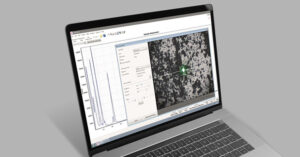
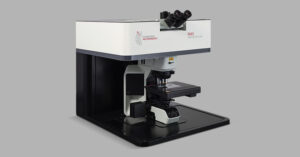
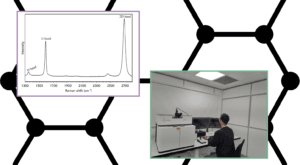
Raman spectroscopy is one of the most powerful tools for graphene characterisation, but a single spectrum only tells part of the story. In this video, we demonstrate how the Edinburgh Instruments RM5 Confocal Raman Microscope can rapidly generate Raman maps that reveal spatial variations in graphene structure and quality across an entire sample. 

From Spectra to Images 

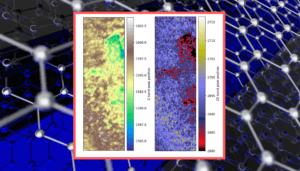
Rather than analysing a single measurement point, Raman mapping collects spectra across a defined area of the sample to build a spatial picture of material properties. Using the RM5, high-resolution maps can be acquired in just a few minutes, transforming Raman data into intuitive visual representations of graphene structure. 

Understanding Graphene Layer Number 

One of the most widely used Raman metrics for graphene is the ratio between the 2D and G bands. Mapping this ratio across the sample allows regions of monolayer, bilayer and multilayer graphene to be quickly distinguished, providing an immediate assessment of sample uniformity. 

Revealing Defects and Strain 

Raman mapping also highlights local variations in material quality. By monitoring D-band intensity, researchers can locate regions with increased defect density, while shifts in Raman peak position provide insight into strain and mechanical effects within the graphene lattice. 

Together, these measurements provide a fast, non-destructive way to evaluate graphene quality and understand how material properties vary across the sample. 

Watch the Full Demonstration 

In the video, we walk through the complete workflow, from defining the mapping area and collecting data to analysing layer number, defect density and strain using Raman maps generated on the RM5. 
Read More Read Less

RELATED PRODUCTS

RMS1000

Multimodal Confocal Microscope

VIEW

Ramacle®

Software for the RM5 and RMS1000

VIEW

RM5

Raman Microscope

VIEW

Contact our expert team today to find out more about how our products can improve your research

Contact Us
PrevPrevious
Previous Unravelling Mechanistic Pathways in Photoredox Catalysis

RESOURCES

Tags:
  • Spectral School
  • RM5
  • Raman
Software Highlight
Realted eBook:

Graphene eBook

View more »
Featured Product:

Ramacle® Software

View more »

RM5 Raman Microscope

View more »
Suggested Reading:

Raman Imaging Of Strain In Graphene

View more »

Graphene Analysis: How to Configure Your Raman Microscope

View more »

How to Aquire Great Raman Spectra of Graphene

View more »
Share:

Keep up to date with the latest from Edinburgh Instruments

Join our mailing list and keep up with our latest videos, app notes and more!

LOCATION:
  • Edinburgh Instruments Ltd.
    2 Bain Square, Kirkton Campus, Livingston, EH54 7DQ
  • sales@edinst.com
  • +44 1506 425 300
ABOUT:
  • About Edinburgh Instruments
  • Techniques
  • Applications
  • Knowledgebase
  • About Edinburgh Instruments
  • Techniques
  • Applications
  • Knowledgebase
PRODUCTS:
  • Fluorescence Spectrometers
  • Raman Microscopes
  • UV-Vis Spectrophotometers
  • Transient Absorption
  • FTIR Spectrometers
  • Lasers and LEDs
  • Customisation Options
  • Software
  • Upgrades
  • All Products
  • Fluorescence Spectrometers
  • Raman Microscopes
  • UV-Vis Spectrophotometers
  • Transient Absorption
  • FTIR Spectrometers
  • Lasers and LEDs
  • Customisation Options
  • Software
  • Upgrades
  • All Products
LEGALS:
  • News
  • Events
  • Blog
  • Careers
  • Distribution & Agents
  • Contact Us
  • Terms and Conditions
  • Privacy Policy
  • Coordinated Vulnerability Disclosure Policy
  • News
  • Events
  • Blog
  • Careers
  • Distribution & Agents
  • Contact Us
  • Terms and Conditions
  • Privacy Policy
  • Coordinated Vulnerability Disclosure Policy
SOCIALS:
Youtube Linkedin X-twitter Facebook
©2026 Edinburgh Instruments. Registered in England and Wales No: 962331. VAT No: GB 271 7379 37
Manage Consent
To provide the best experiences, we use technologies like cookies to store and/or access device information. Consenting to these technologies will allow us to process data such as browsing behaviour or unique IDs on this site. Not consenting or withdrawing consent, may adversely affect certain features and functions.
Functional Always active
The technical storage or access is strictly necessary for the legitimate purpose of enabling the use of a specific service explicitly requested by the subscriber or user, or for the sole purpose of carrying out the transmission of a communication over an electronic communications network.
Preferences
The technical storage or access is necessary for the legitimate purpose of storing preferences that are not requested by the subscriber or user.
Statistics
The technical storage or access that is used exclusively for statistical purposes. The technical storage or access that is used exclusively for anonymous statistical purposes. Without a subpoena, voluntary compliance on the part of your Internet Service Provider, or additional records from a third party, information stored or retrieved for this purpose alone cannot usually be used to identify you.
Marketing
The technical storage or access is required to create user profiles to send advertising, or to track the user on a website or across several websites for similar marketing purposes.
  • Manage options
  • Manage services
  • Manage {vendor_count} vendors
  • Read more about these purposes
View preferences
  • {title}
  • {title}
  • {title}