Photoredox catalysis harnesses light to drive chemical transformations via electronically excited molecules. But observing that a reaction works is only the beginning. To optimise a photocatalytic reaction, researchers need to understand what happens after a photon is absorbed, which excited-state pathways are involved, and which processes ultimately control reaction efficiency.
In this Edinburgh Instruments webinar, Ludovic Troian-Gautier explores how complementary spectroscopic techniques can unravel the mechanisms behind photoredox catalysis, from initial light absorption to reactive intermediates and product formation.
Routine techniques provide a powerful starting point. UV-Visible absorption spectroscopy reveals where a molecule absorbs light and helps assess photostability, while steady-state photoluminescence provides information about excited-state energy. Combined with electrochemistry, these measurements can be used to understand excited-state redox properties and identify feasible photochemical transformations.
Steady-state and time-resolved photoluminescence quenching can investigate the first step on light-induced transformations relying on bimolecular excited-state reactivity. Using the Stern-Volmer approach, researchers can access the quenching rate constant, kq, and determine whether quenching occurs dynamically through diffusion or statically through pre-association.
However, quenching alone does not identify the underlying pathway. For example, Stern-Volmer analysis on its own cannot determine whether quenching arises from electron transfer or energy transfer.
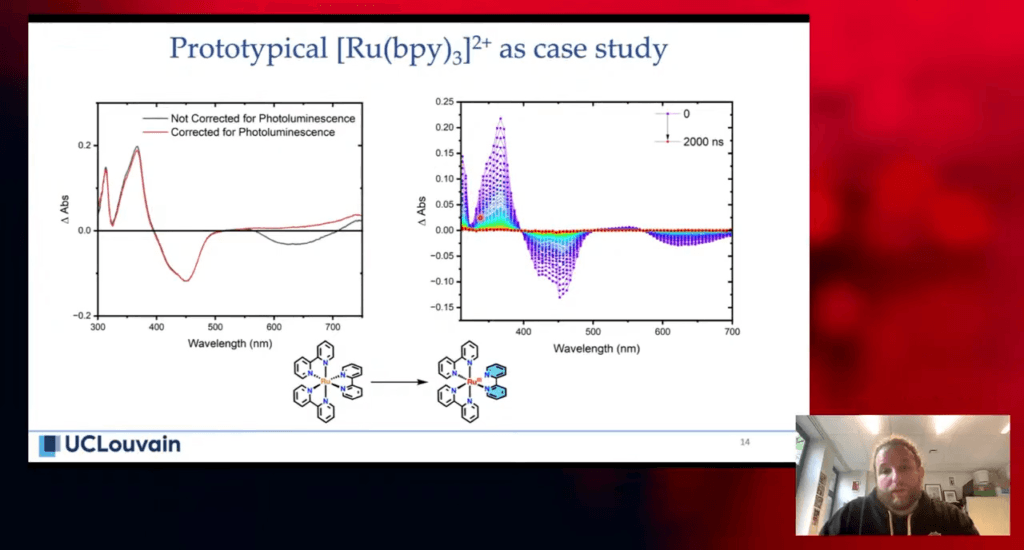
Transient absorption spectroscopy enables researchers to follow short-lived excited states, radicals and photoproducts after photoexcitation. In the webinar, the prototypical [Ru(bpy)₃]²⁺ complex is used to illustrate how transient spectra can be interpreted and connected with the spectra of individual chemical species.
The approach can distinguish between electron and energy transfer pathways, determine rate constants for photoinduced electron transfer and subsequent chemistry, and provide information about the concentration of radicals generated per absorbed photon through cage escape yield measurements.
Studies of an iron(III) photosensitiser illustrated that successful excited-state quenching does not necessarily translate directly into productive chemistry. Nanosecond transient absorption measurements were consistent with reductive electron transfer, but photoproduct formation varied strongly with solvent, with clear product formation observed in dichloromethane and much smaller amounts in acetonitrile and DMF.
Further reaction studies showed that cage escape yield controls overall reaction yield, connecting ultrafast molecular events with the outcome observed in synthetic chemistry.
Watch the full webinar to hear Ludovic Troian-Gautier explore the spectroscopy behind photoredox catalysis and show how mechanistic insight can help guide the development of light-driven chemical reactions.