Skip to content
  • News
  • Events
  • eBooks
  • Blog
  • Careers
  • Contact
  • News
  • Events
  • eBooks
  • Blog
  • Careers
  • Contact
KNOWLEDGEBASE
  • About Us
  • Products

    Fluorescence Spectrometers:

    • FLS1000 Photoluminescence Spectrometer
    • FS5 Spectrofluorometer
    • LifeSpec II Lifetime Spectrometer
    • Mini-tau Lifetime Spectrometer

    Raman Microscopes:

    • RM5 Raman Microscope
    • RMS1000 Multimodal Confocal Microscope

    Transient Absorption:

    • LP980 Transient Absorption Spectrometer

    FTIR Spectrometers:

    • IR5 FTIR Spectrometer

    Lasers and LEDs:

    • Pulsed Lasers
    • Gas Lasers

    Options:

    • Upgrades
    • Customisation
    View All Products
  • Techniques
  • Applications
KNOWLEDGEBASE
  • About Edinburgh Instruments
  • Products
  • Techniques
  • Applications
  • Knowledgebase
  • eBooks
  • News
  • Events
  • Blog
  • Careers
  • Contact Us

RESOURCES

Ramacle® – Cosmic Ray Removal

  • May 13, 2026

KEY POINTS

  • Ramacle® automatically detects and removes cosmic ray artefacts across single spectra and large Raman datasets, delivering fast, reliable data processing.
  • By clearing sharp spikes and structured false features, Ramacle® preserves true Raman signals and increases both qualitative and quantitative accuracy.
  • With adjustable detection parameters and manual review tools, Ramacle® lets users fine‑tune cosmic ray removal for any sample or experimental setup.

Automated Removal of Spectral Artefacts 

Ramacle® is a comprehensive, user‑friendly software package designed for the complete operation and control of Edinburgh Instruments’ Raman systems. Among its many advanced data‑handling tools, Ramacle includes automatic cosmic ray removal, enabling fast and reliable elimination of unwanted spectral artefacts. 

This feature is optimised for both single Raman spectra and large Raman datasets, including maps containing thousands of individual spectra. By removing cosmic rays efficiently and consistently, Ramacle helps ensure that your data accurately represents your sample and supports confident interpretation and downstream analysis. 


What are Cosmic Rays?

Cosmic rays are high-energy particles originating from space that can interact with the CCD detector used in Raman spectrometers. When a cosmic ray strikes the detector during data acquisition, it produces an unwanted signal that appears in the spectrum. 

These events are random and unavoidable. In Raman spectra, they typically manifest as sharp, high‑intensity spikes that do not correspond to any real chemical or structural feature of the sample. In some cases, cosmic rays may also appear as broader or more complex artefacts, making them harder to distinguish from genuine Raman bands. 

When collecting large datasets, such as Raman maps, the likelihood of cosmic ray events increases significantly. Removing these artefacts at an early stage ensures cleaner data and more reliable results throughout your analysis pipeline. 


Why is it Important to Remove Cosmic Rays?

Cosmic rays introduce false features into Raman spectra, which can obscure or distort real sample information. If left uncorrected, they can negatively impact both qualitative interpretation and quantitative analysis. 

These can appear as spikes in the baseline of the spectrum or overlapping with a Raman band. They can also appear as broader, more structured features which may be mistaken for true Raman peaks (Figure 1).  
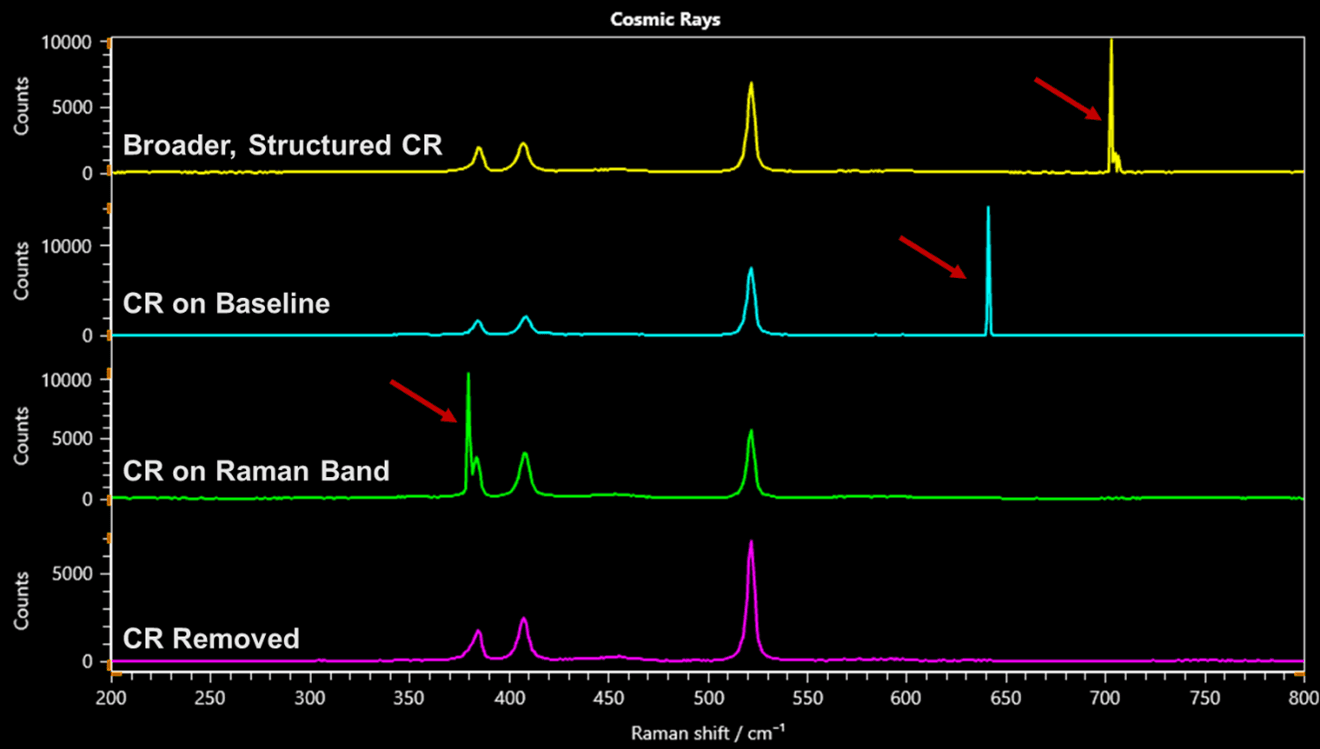
 

Example of cosmic ray (CR) artefacts appearing as sharp spikes and structured features in Raman spectra.

Figure 1. Example of cosmic ray (CR) artefacts appearing as sharp spikes and structured features in Raman spectra.


Cosmic rays can: 

  • Mask real Raman features, particularly weak or narrow bands. 
  • Complicate visualisation of Raman maps, such as intensity maps. 
  • Distort the shape and intensity of genuine Raman peaks, leading to misinterpretation. 
  • Introduce errors into data processing workflows, especially techniques that rely on the full spectrum, including multivariate and chemometric analyses. 


Automatic Cosmic Ray Removal in Ramacle

Ramacle software includes automated cosmic ray removal functionality that eliminates cosmic rays from both individual spectra and entire Raman maps. 

Cosmic rays are identified based on their characteristic intensity, width, and spectral profile, and are removed while preserving the underlying Raman signal. The process is fast and consistent, making it particularly effective for large datasets where manual correction would be impractical. 

The impact of cosmic rays on a Raman map containing thousands of spectra is illustrated in Figure 2. Before cosmic ray removal, the map is dominated by these artefacts, that distort the image (Figure 2A). This skews colour intensity values and obscures genuine sample features. 

After cosmic ray removal, the map no longer contains outliers or artefacts (Figure 2B). This improves visual clarity, enables spatial features to be resolved, and ensures that subsequent quantitative analysis accurately reflects the underlying data. 
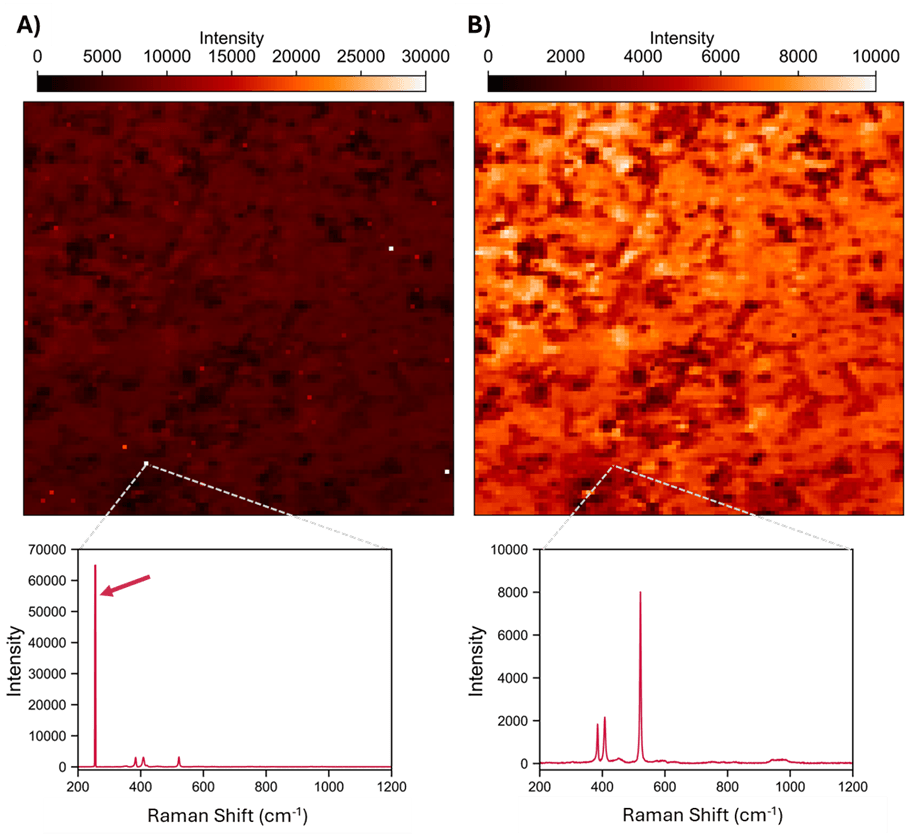


Raman map of molybdenum disulfide (MoS2) on silicon wafer showing spatial signal intensity variation of whole spectrum A) Before cosmic ray removal, and B) After automatic cosmic ray removal with Ramacle.

Figure 2. Raman map of molybdenum disulfide (MoS2) on silicon wafer showing spatial signal intensity variation of whole spectrum A) Before cosmic ray removal, and B) After automatic cosmic ray removal with Ramacle.


User‑Adjustable Parameters for Optimal Results

While Ramacle’s default settings are suitable for most applications, the software also provides user‑adjustable parameters to accommodate different samples, acquisition conditions, and detector settings (Figure 3). 

Users can fine‑tune the cosmic ray removal process by adjusting: 

  • Intensity threshold factor – controls the sensitivity of cosmic ray detection 
  • Maximum width – defines the widest feature considered to be a cosmic ray 
  • Minimum height – filters out baseline noise so the software only processes significant intensity spikes 

Once cosmic rays are automatically identified, users can review all detected events in the raw spectra and remove any false positives if required. Additionally, users can manually select cosmic rays via the ‘Custom’ tab for events that are not detected automatically. 

This flexibility allows experienced users to optimise performance for challenging samples or specialised experiments, ensuring that all cosmic rays are removed without affecting genuine Raman features. 
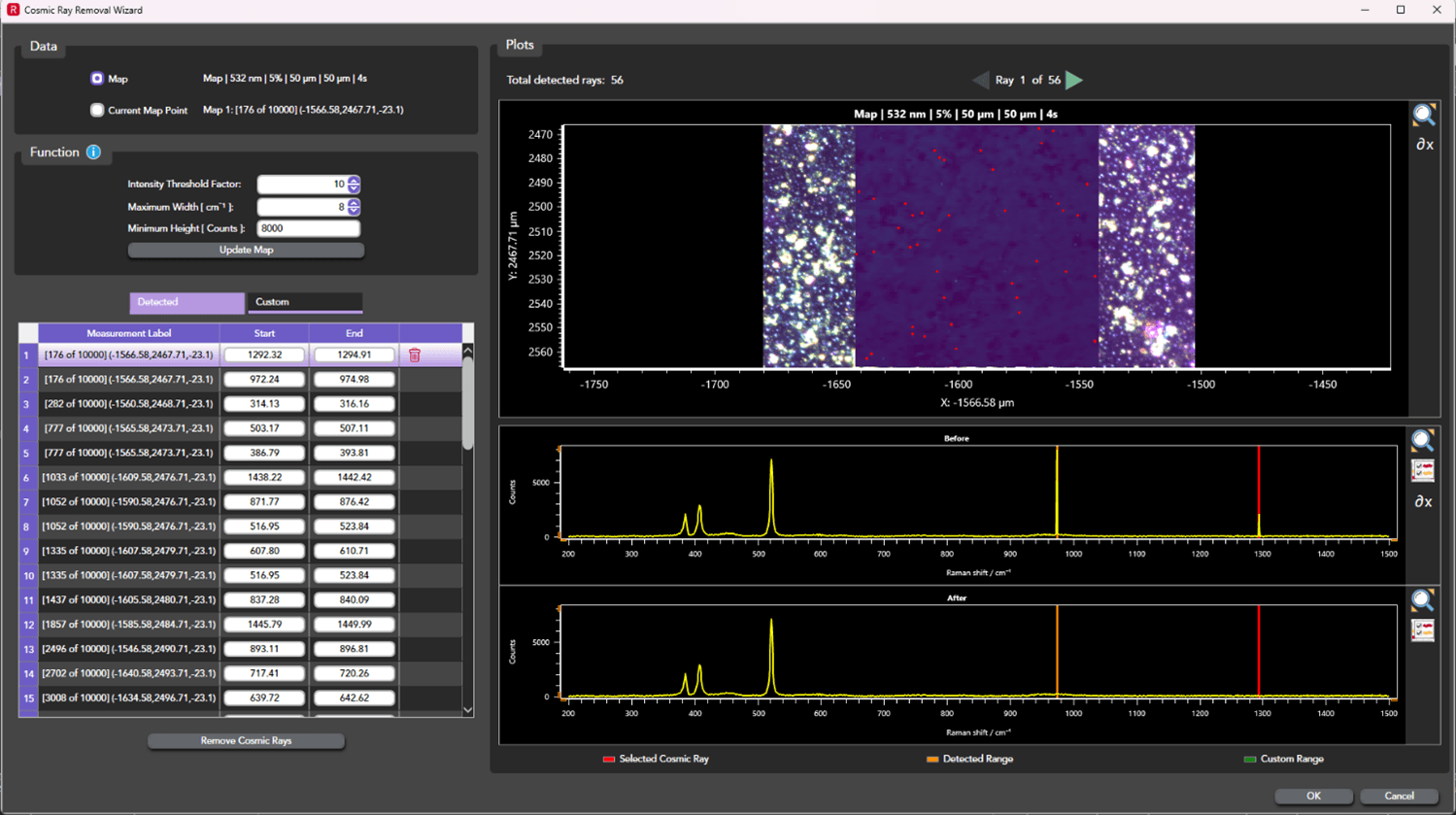
 

Cosmic Ray Removal in Ramacle software

Figure 3. Cosmic Ray Removal in Ramacle software.


Clean Data, Confident Analysis

Automatic cosmic ray removal in Ramacle simplifies Raman data processing and helps users focus on their true Raman features and results. By efficiently eliminating spectral artefacts from both small and large datasets, Ramacle delivers cleaner spectra, clearer maps, and more reliable analysis. 

Whether you are performing routine measurements or advanced chemometric analysis, Ramacle’s cosmic ray removal tools provide a robust foundation for high‑quality Raman spectroscopy. 
RELATED PRODUCTS

RMS1000

Multimodal Confocal Microscope

VIEW

RM5

Raman Microscope

VIEW

Contact our expert team today to find out more about how our products can improve your research

Contact Us
PrevPrevious
Previous Choosing Detectors for your FLS1000 Photoluminescence Spectrometer

RESOURCES

Tags:
  • Software Highlight
  • RM5
  • RMS1000
  • Raman
Software Highlight
Download PDF
Featured Product:

RMS1000 Raman Microscope

View more »
Suggested Reading:

Ramacle® Software Highlight: FastMAP®

View more »

Ramacle® Software Highlight: SurfMAP®

View more »
Share:

Keep up to date with the latest from Edinburgh Instruments

Join our mailing list and keep up with our latest videos, app notes and more!

LOCATION:
  • Edinburgh Instruments Ltd.
    2 Bain Square, Kirkton Campus, Livingston, EH54 7DQ.
  • sales@edinst.com
  • +44 1506 425 300
ABOUT:
  • About Edinburgh Instruments
  • Techniques
  • Applications
  • Knowledgebase
  • About Edinburgh Instruments
  • Techniques
  • Applications
  • Knowledgebase
PRODUCTS:
  • Fluorescence Spectrometers
  • Raman Microscopes
  • UV-Vis Spectrophotometers
  • Transient Absorption
  • FTIR Spectrometers
  • Lasers and LEDs
  • Customisation Options
  • Software
  • Upgrades
  • All Products
  • Fluorescence Spectrometers
  • Raman Microscopes
  • UV-Vis Spectrophotometers
  • Transient Absorption
  • FTIR Spectrometers
  • Lasers and LEDs
  • Customisation Options
  • Software
  • Upgrades
  • All Products
LEGALS:
  • News
  • Events
  • Blog
  • Careers
  • Distribution & Agents
  • Contact Us
  • Terms and Conditions
  • Privacy Policy
  • News
  • Events
  • Blog
  • Careers
  • Distribution & Agents
  • Contact Us
  • Terms and Conditions
  • Privacy Policy
SOCIALS:
Youtube Linkedin X-twitter Facebook
©2024 Edinburgh Instruments. Registered in England and Wales No: 962331. VAT No: GB 271 7379 37
Manage Consent
To provide the best experiences, we use technologies like cookies to store and/or access device information. Consenting to these technologies will allow us to process data such as browsing behaviour or unique IDs on this site. Not consenting or withdrawing consent, may adversely affect certain features and functions.
Functional Always active
The technical storage or access is strictly necessary for the legitimate purpose of enabling the use of a specific service explicitly requested by the subscriber or user, or for the sole purpose of carrying out the transmission of a communication over an electronic communications network.
Preferences
The technical storage or access is necessary for the legitimate purpose of storing preferences that are not requested by the subscriber or user.
Statistics
The technical storage or access that is used exclusively for statistical purposes. The technical storage or access that is used exclusively for anonymous statistical purposes. Without a subpoena, voluntary compliance on the part of your Internet Service Provider, or additional records from a third party, information stored or retrieved for this purpose alone cannot usually be used to identify you.
Marketing
The technical storage or access is required to create user profiles to send advertising, or to track the user on a website or across several websites for similar marketing purposes.
  • Manage options
  • Manage services
  • Manage {vendor_count} vendors
  • Read more about these purposes
View preferences
  • {title}
  • {title}
  • {title}