Dr. Rossana Dell’Anna leads the spectroscopic characterisation laboratories at Fondazione Bruno Kessler (FBK), where Raman and photoluminescence (PL) spectroscopy underpin their research in quantum and nanotechnologies. Within the Centre for Sensors & Devices, the group focuses on developing quantum-photon platforms through ion implantation and advanced optical characterisation of colour centres in wide-bandgap semiconductors.
To expand these capabilities, Edinburgh Instruments has worked with FBK to develop an RMS1000 Multimodal Microscope configured with a Hanbury Brown–Twiss (HBT) Interferometer for antibunching determination (Figure 1). This setup enables photoluminescence lifetime measurements of colour centres as well as experimental verification of single-photon emission. The RMS1000 provides a complete workflow for assessing the quantum properties of single photon emitters fabricated through FBK’s ion implantation processes.
This work is carried out by a multidisciplinary team including Damiano Giubertoni, Giorgio Speranza, Antonino Picciotto, Georg Pucker, Elena Missale, Elia Scattolo, Alessandro Cian, Andrea Pegoretti, and Elena Nieto Hernandez.
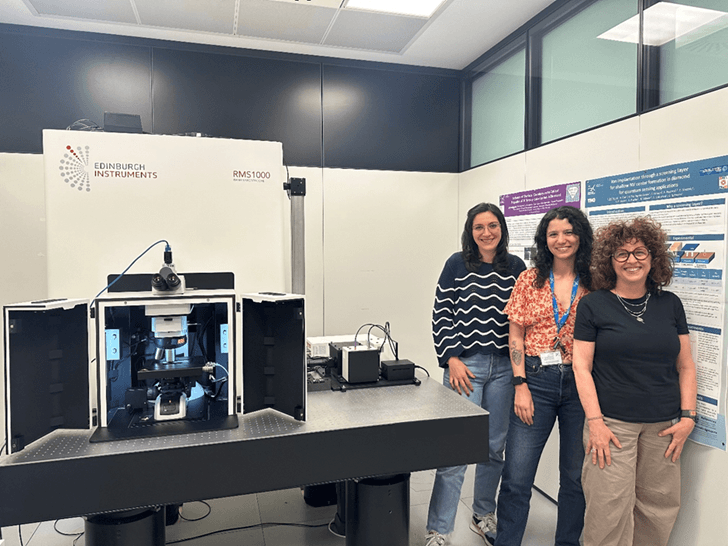
Figure 1. Dr Rossana Dell’Anna, Dr Elena Missale and Dr Elena Nieto Hernández and their RMS1000 with Hanbury Brown-Twiss Interferometer.
To facilitate colour centre studies, Edinburgh Instruments have developed an upgrade for the RMS1000 Multimodal Microscope equipped for antibunching experiments (Figure 2). The system integrates a 515 nm CW laser, HPL-450 pulsed diode laser, electron-multiplying charge–coupled device (EMCCD) detector, and external HBT interferometry module coupled to an external port. The HBT module includes two high-speed hybrid photomultiplier tube detectors (HS-HPD) for high sensitivity coincidence measurements and PL lifetime measurements.
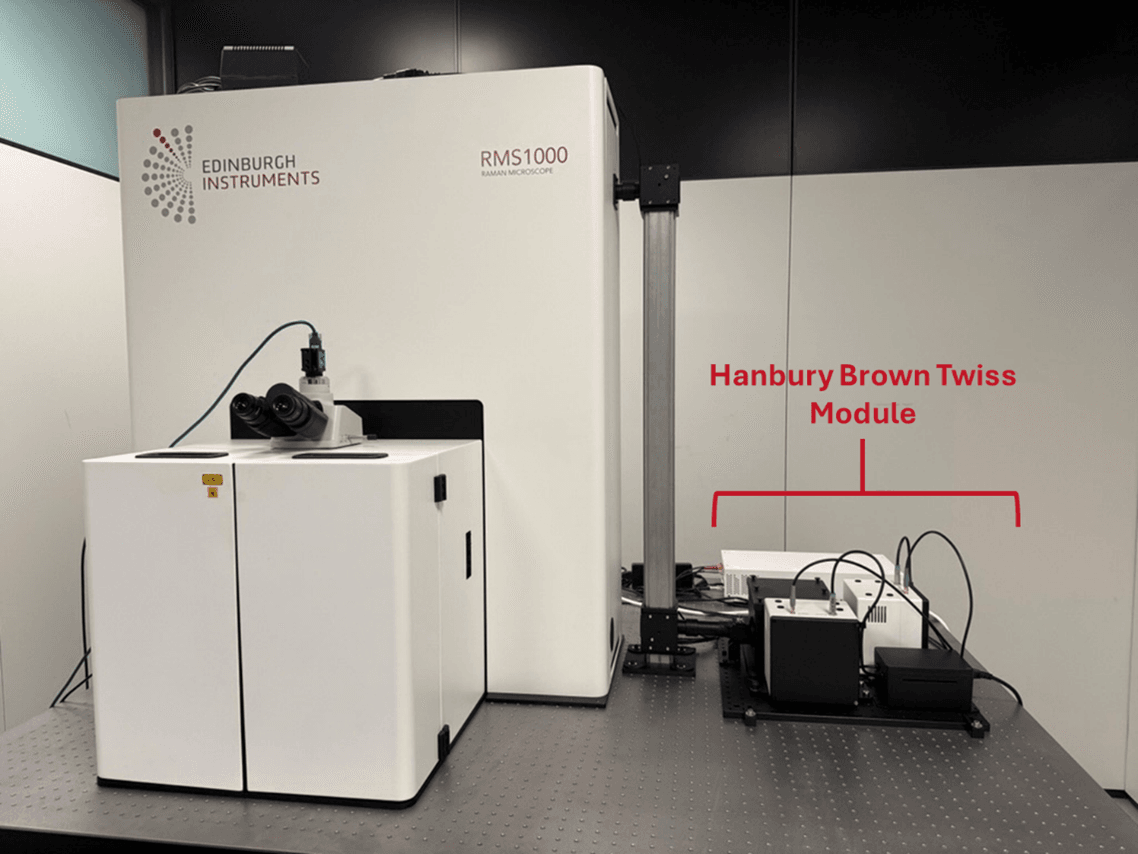
Figure 2. RMS1000 Multimodal Microscope configured for Hanbury Brown-Twiss interferometry experiments.
Because the antibunching module is externally coupled, existing FLS1000 systems with MicroPL and RMS1000 systems can be easily upgraded for antibunching experiments.
Using their RMS1000, the FBK team investigates germanium vacancy (GeV) centres in electronic grade diamond as single photon emitters. Their sample consists of CVD diamond implanted with germanium ions at Poisson–limited fluences, followed by thermal treatment to activate GeV centres.
Implantation is carried out using a focused ion beam (FIB) system equipped with a liquid metal ternary alloy (Si–Au–Ge) ion source (Velion system, Raith GmbH, Germany), providing nanoscale spatial control over ion delivery. In the low-dose regime, where the colour-centre formation yield (determined from dose-dependent statistics of fabricated centres) is below unity, this approach enables reliable and repeatable fabrication of single GeV centres.
PL imaging using the EMCCD camera reveals spatially localised emission sites (Figure 3A). High intensity points displayed a clear zero phonon line at ~602 nm (Figure 3C), characteristic of the GeV centre, while background regions exhibit only diamond Raman features (Figure 3B, where only the second-order diamond Raman peaks are visible). This confirms that GeV emission was confined to the implanted sites.
To verify single photon emission, g(2)(τ) measurements were acquired from high intensity PL regions (Figure 3D). After background correction, the data exhibited a pronounced antibunching dip at τ = 0. The g(2)(0) value was 0.19 which satisfies the <0.5 criterion that confirms single photon emission.

Figure 3. Antibunching measurements of GeV centres in diamond. A) PL intensity map of sample showing intensity of peak at around 602 nm, B) Background spectrum, C) Spectrum of GeV highlighting zero-phonon band at 602 nm, D) g(2)(τ) plot of GeV centres.
These measurements demonstrate that the implanted GeV centres behave as isolated quantum emitters and validate FBK’s fabrication approach for quantum applications.
Beyond diamond, FBK is also active in the fabrication and integration of defect-based emitters in other semiconductors, such as silicon carbide and silicon, which host colour centres emitting in the near-infrared and telecom ranges. These systems offer strong potential for integrated quantum photonics and are particularly attractive for scalable quantum technologies due to their compatibility with established fabrication platforms.
The RMS1000 system will soon be upgraded with a NIR-sensitive spectral setup capable of detecting single-photon emission and measuring emitter lifetimes across the NIR and telecom spectral range.
We look forward to seeing how Dr. Rossana Dell’Anna and the FBK team continue advancing single photon research using the RMS1000 platform.
We would like to thank our customers at Fondazione Bruno Kessler for sample fabrication and analysis.
Fabrication: A. Cian, E. Scattolo, and D. Giubertoni.
Measurement: E. Missale, E. Nieto Hernandez, and R. Dell’Anna.