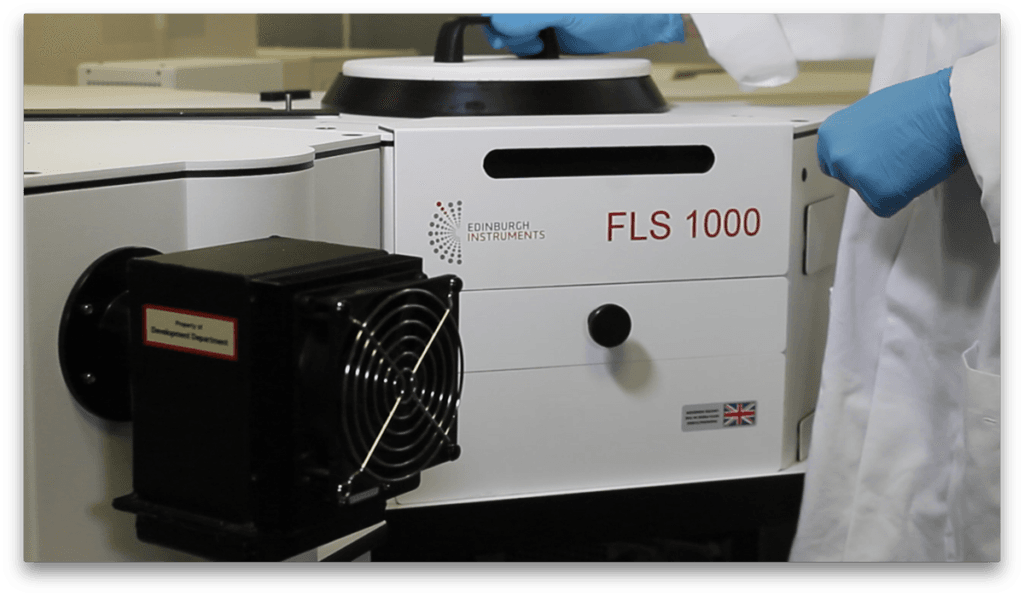
In this Technical Note, we guide you through selecting the most suitable detector configuration for the FLS1000 Photoluminescence Spectrometer. It outlines the key considerations when choosing between photon-counting photomultiplier tubes (PMTs) and analogue detectors, based on sample characteristics and measurement requirements. Readers with a particular interest in near-infrared (NIR) detection are encouraged to consult the companion Technical Note, “Near Infrared PMT Options for the FLS1000 Photoluminescence Spectrometer”.
The FLS1000 can accommodate various PMTs and analogue detectors. PMTs are the default option for photoluminescence in the visible spectral range, while NIR detection can be performed with photon-counting or analogue detectors. Some key features to consider when selecting your optimal detector module include:
Photon-Counting PMTs
Analogue Detectors (e.g., InGaAs, InAs, InSb):
The most important factor when choosing a detector is whether it can cover the full emission range of your sample. Each PMT has a specific spectral sensitivity window, and measurements are only possible within this range. The ability of a PMT to detect light and convert photons into an electrical signal is measured by its quantum efficiency (QE). This conversion occurs at the PMT’s photocathode, where incoming photons produce photoelectrons. These photoelectrons are then accelerated and amplified by the PMT’s dynodes. The QE at a specific wavelength is usually given as a percentage and is defined as:

The PMT-900 is the standard option for visible-range detection. It is suitable for most samples emitting in the 200 nm – 870 nm region and offers excellent performance for general photoluminescence applications. If the sample emission extends to ~950 nm, the PMT-900 can be replaced with the PMT-980, which has extended spectral coverage. The QE curves for both detectors are shown in Fig. 1.
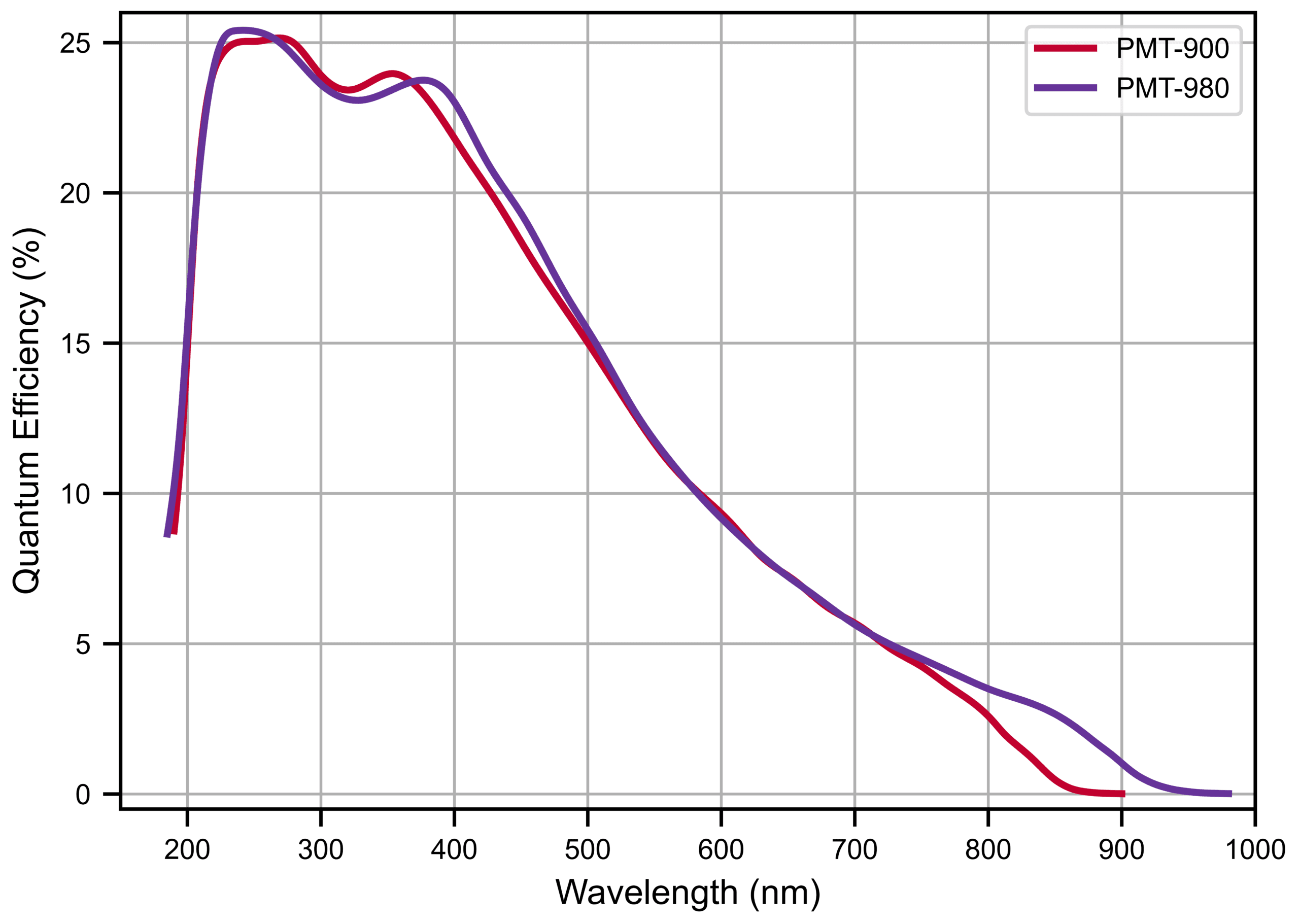
Figure 1. QE curves of the PMT-900 and -980.
If your sample emission extends further into the NIR or mid-infrared (MIR) region, additional detectors are required. You can choose from the available PMTs, either liquid nitrogen- or thermoelectrically (LN2 or TE)-cooled, or the analogue detector options listed in Tables 1 and 2, respectively. These detectors complement the visible PMTs and can be used as 2nd or 3rd detectors on the same FLS1000 system.
Table 1. Available PMT options for the visible and NIR regions, along with their corresponding spectral ranges.
Photon Counting Detector Range
PMT-900 200 nm – 870 nm
PMT-980 200 nm – 980 nm
PMT-1010 200 nm – 1010 nm
PMT-1400-LN2 500 nm – 1400 nm
PMT-1400-TE 930 nm – 1400 nm
PMT-1700-LN2 500 nm – 1700 nm
PMT-1700-TE 930 nm – 1700 nm
Table 2. Available analogue detector options for the NIR and MIR regions, along with their corresponding spectral ranges.
Analogue Detector Range
InGaAs-1650-TE 800 nm – 1650 nm
InGaAs-2050-TE 900 nm – 2050 nm
InGaAs-2550-TE 900 nm – 2550 nm
InAs-3100-LN2 1200 nm – 3100 nm
InSb-5500-LN2 1500 nm – 5500 nm
Important considerations that should be kept in mind:
Not all samples emit light with the same intensity. Some produce very weak photoluminescence, particularly in the NIR/MIR regions. The detector’s sensitivity is crucial in these instances. A measure of the detector’s sensitivity that incorporates QE, dark count rate, and noise-equivalent power (NEP) is the number of photons per second required to achieve a signal-to-noise ratio (SNR) of 1. That is:

where λ is the wavelength of light incident on the detector, h is Planck’s constant and c is the speed of light in vacuum.
Figures 2 and 3 present a sensitivity comparison using Eq. 2 for all the available FLS1000 detectors. Figure 2 shows a sensitivity comparison between the available PMTs up to 1700 nm, and Figure 3 shows a comparison between the analogue detectors up to 5.5 μm. Note that the higher the value on the y-axis, the less sensitive the detector is, as this figure is the number of photons per second required to achieve an SNR of 1. The figure shows that PMTs can be up to 1,000,000 times more sensitive than analogue detectors at similar wavelengths. Photon-counting PMTs are therefore strongly encouraged in applications with low sample brightness. If your spectral region of interest lies in the MIR, an analogue detector is the only option. It should be paired with a powerful light source, such as a high-power laser, to offset the detector’s low yield by providing more excitation photons.
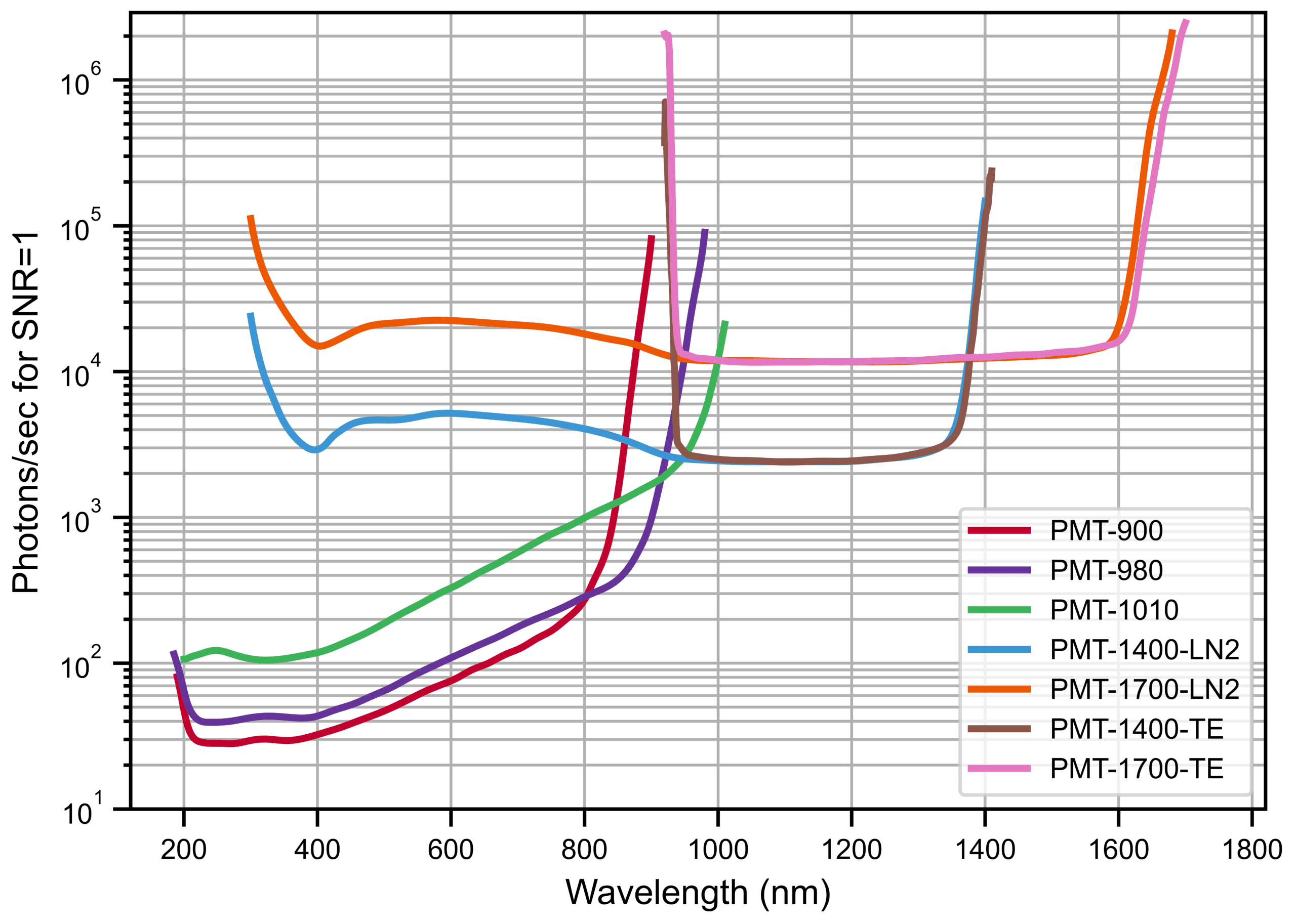
Figure 2. Photons/s required to obtain a signal-to-noise ratio equal to 1 for the FLS1000 PMT detector options up to 1700 nm.
Figure 3. Photons/s required to obtain a signal-to-noise ratio equal to 1 for the FLS1000 analogue detector options up to 5.5 μm.
Photoluminescence Quantum Yield (PLQY) measurements require capturing both the absorption and emission regions. In most cases, these regions are close together, allowing measurements to be made with a single detector. However, some materials have absorption and emission ranges that are far apart. In such cases, two detectors are necessary: one to measure the absorption peak and another to measure the emission peak. For example, a suitable detector combination is PMT-900/980 paired with NIR PMT-1700-LN2. This setup works well for samples that absorb in the UV or visible spectrum (~350 nm – 600 nm) and emit in the NIR (~1000 nm – 1650 nm), such as rare-earth-based materials. The 500 nm – 980 nm range is the overlapping region, as Edinburgh Instruments can supply correction files for the LN2 NIR PMT detectors starting at 500 nm. Similarly, for PLQY measurements requiring an analogue detector, such as an InGaAs, correction files are available from 600 nm onwards. Table 3 summarises all the visible and NIR detector combinations suitable for PLQY measurements.
Table 3. Summary of the possible and non-possible combinations of visible and NIR detectors for PLQY measurements.
Detector PMT-1400-LN2 PMT-1400-TE PMT-1700-LN2 PMT-1700-TE InGaAs-1650-TE InGaAs-2050-TE InGaAs-2550-TE
PMT-900 Possible Not possible Possible Not possible Possible Possible Possible
PMT-980 Possible Not possible Possible Not possible Possible Possible Possible
PMT-1010 Possible Possible Possible Possible Possible Possible Possible
Note that the PMT-1010 is not recommended as the only visible PMT in a system, as its QE is lower than that of a PMT-900/980. However, it is the ideal choice for upconversion PLQY at 980 nm excitation, enabling measurement of both the sample’s excitation and emission peaks.
If you require time-resolved photoluminescence (TRPL), then the detector’s time response becomes essential. The shortest measurable lifetime depends on the Instrument Response Function (IRF), which describes the instrument’s temporal response. The IRF depends on several factors, including the pulse width of the source, the detector’s temporal response, the electronics’ timing jitter, which is typically around 20 ps, and the monochromator’s dispersion, which becomes noticeable only in the picosecond time regime. These factors can be summarised in Eq. 3 as:

FWHMdetector refers to the detector’s temporal resolution. In PMTs, this is characterised by the transit time spread (TTS). Transit time is the time it takes for photoelectrons emitted from the PMT’s photocathode to reach the anode after being multiplied by the dynodes. Each photoelectron has a unique transit time, and TTS accounts for the statistical variation in the arrival times of these electrons. A lower TTS indicates better time resolution, enabling the measurement of shorter lifetimes. For example, the standard PMT-900 has a TTS of 600 ps, whereas the high-speed hybrid photodetector (HS-HPD) has a TTS of approximately 40 ps.
Fast detectors are often less sensitive than standard PMTs and are therefore used only for lifetime measurements. In the time-correlated single-photon counting method (TCSPC), the theoretical minimum measurable lifetime can be approximated by one-tenth of the FWHMIRF, whereas a more practical minimum estimate is given by one-third of the FWHMIRF, as:
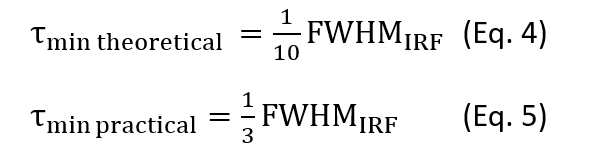
While Eq. 4 is the most frequently quoted minimum achievable lifetime, it is valid only under ideal experimental conditions: the sample must be a solution, and its lifetime decay curve should consist of a single exponential component. One-third of the FWHMIRF (Eq. 5) is, therefore, a more practical estimate, as it improves fit reliability when measuring not only solutions with a single exponential component but also solid-state samples with multiexponential lifetime decays. More details are available in our technical note which focuses on minimum measurable lifetimes in the FLS1000.
Analogue detectors, as non-photon-counting devices, produce a voltage signal proportional to the incident PL intensity. To record these rapid analogue signals (transients) over time, a fast oscilloscope is required for TRPL. Edinburgh Instruments has developed TDS electronics that simplify NIR/MIR analogue detector measurements, eliminating the need for an external oscilloscope. Therefore, TDS detectors are recommended for their ease of use. However, PL lifetimes shorter than 1 μs require the external oscilloscope option, which offers higher time resolution. Oscilloscope detectors are ideally paired with high-power nanosecond lasers such as Nd:YAG lasers.
Tables 4 and 5 summarise the spectral and temporal characteristics, as well as the typical application fields, of the available PMT detectors for the FLS1000.
Table 4. Summary of the parameters of the available PMT detector options for the FLS1000.
Detector Spectral Range (nm) Cooling TTS Typical Applications
PMT-900 200–870 Uncooled or Thermoelectric 600 ps General PL, TRPL in the visible range
PMT-980 200–950 Thermoelectric 600 ps General PL, TRPL in the visible range
PMT-1010 200-1010 Thermoelectric 800 ps PLQY for upconversion materials
PMT-1400-TE 950–1400 Thermoelectric 400 ps Highest sensitivity NIR PL, singlet oxygen measurements
PMT-1400-LN2 500-1400 Liquid Nitrogen 800 ps Highest sensitivity NIR PL
PMT-1700-TE 950-1700 Thermoelectric 400 ps High sensitivity deep NIR detection
PMT-1700-LN2 500–1700 Liquid Nitrogen 800 ps High sensitivity deep NIR detection, visible detection
High-Speed PMT 230-850 Thermoelectric 180 ps Fast decays, narrow IRF
High-Speed Hybrid Photodetector 220-870 Thermoelectric < 40 ps Ultrafast dynamics, narrowest IRF
Table 5. Summary of the available analogue detector options for the FLS1000.
Detector Spectral Range (nm) Cooling IRF
InGaAs-1650-TE 870 nm – 1650 nm Thermoelectric 100 ns
InGaAs-2050-TE 900 nm – 2050 nm Thermoelectric 100 ns
InGaAs-2550-TE 900 nm – 2550 nm Thermoelectric 150 ns
InAs-3100-LN2 1200 nm – 3100 nm Liquid Nitrogen ~150 ns
InSb-5500-LN2 1500 nm – 5500 nm Liquid Nitrogen 500 ns
Choosing the right detector for the FLS1000 involves:
Edinburgh Instruments provides expert guidance on selecting detectors that match gratings, sources, and measurement objectives. Contact us to finalise your system configuration and ensure optimal performance.