Skip to content
  • News
  • Events
  • eBooks
  • Blog
  • Careers
  • Contact
  • News
  • Events
  • eBooks
  • Blog
  • Careers
  • Contact
KNOWLEDGEBASE
  • About Us
  • Products

    Fluorescence Spectrometers:

    • FLS1000 Photoluminescence Spectrometer
    • FS5 Spectrofluorometer
    • LifeSpec II Lifetime Spectrometer
    • Mini-tau Lifetime Spectrometer

    Raman Microscopes:

    • RM5 Raman Microscope
    • RMS1000 Multimodal Confocal Microscope

    Transient Absorption:

    • LP980 Transient Absorption Spectrometer

    FTIR Spectrometers:

    • IR5 FTIR Spectrometer

    Lasers and LEDs:

    • Pulsed Lasers
    • Gas Lasers

    Options:

    • Upgrades
    • Customisation
    View All Products
  • Techniques
  • Applications
KNOWLEDGEBASE
  • About Edinburgh Instruments
  • Products
  • Techniques
  • Applications Old
  • Knowledgebase
  • eBooks
  • News
  • Events
  • Blog
  • Careers
  • Contact Us

RESOURCES

Advancing Sustainable Hydrogen Production with the Raman Microscopy: The Morales Group

  • November 16, 2026

KEY POINTS

  • Researchers in Dr. Dulce M. Morales’ group at the University of Groningen, Netherlands, use the RM5 Confocal Raman Microscope to study electrochemical interfaces for energy-efficient alkaline water electrolysis.
  • Coupling the RM5 with electrochemistry enables in‑situ measurements that reveal potential- and current‑dependent changes in catalysts during operation
  • Raman spectroscopy has been used to quantify the reconstruction of a cobalt‑based metal–organic framework (MOF) catalyst under different electrolyte compositions.
  • Supporting both ex‑situ materials characterisation and in‑situ electrochemical studies, the RM5 is one of the group’s most important research tools.

Electrochemistry for a renewable future

Dr. Dulce M. Morales leads a research group at the University of Groningen within the Engineering and Technology Institute Groningen (ENTEG) (Figure 1). The group focuses on the electrochemical conversion of renewable resources, such as biomass and waste‑derived compounds, into value‑added chemicals and fuels. Alongside this, they develop energy conversion technologies including electrolysers, metal–air batteries and supercapacitors.

Central to the group’s research is the design and in‑depth understanding of electrochemical interfaces, with an emphasis on low‑cost catalytic materials produced from abundant resources.
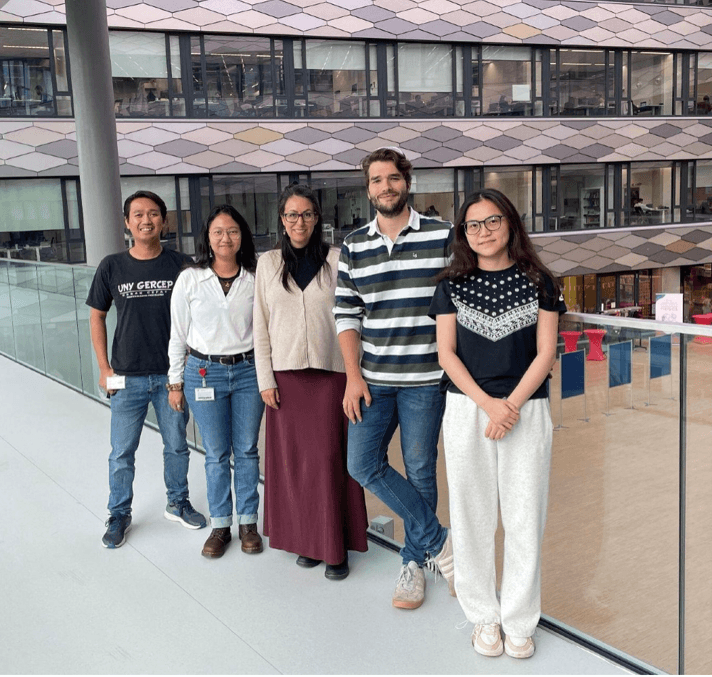
Morales Group | University of Groningen

Figure 1. The Morales Group at the University of Groningen. (L-R) Fika Fauzi, Noe Noe Hnin Waddy, Dulce M. Morales, Floris van Lieshout, Chongyang Jiang.


Replacing the oxygen evolution reaction

Floris van Lieshout, a third‑year PhD student in the group, explores strategies to improve the energy efficiency of alkaline water electrolysis (AWE). In conventional AWE, the anode reaction is the oxygen evolution reaction (OER). The OER is thermodynamically and kinetically challenging, making it a major bottleneck in the energy conversion efficiency of the process.

To overcome this limitation, van Lieshout investigates alternative anode reactions that could replace the OER. One example is the glycerol oxidation reaction (GOR). Glycerol is an abundant byproduct of biodiesel production, and its oxidation requires substantially less energy input than the OER. This means the same volume of hydrogen can be produced while spending less energy. If the anode reaction can also be tuned to proceed selectively, it yields a valuable product, increasing the economic benefit compared with the traditional OER.

The key scientific challenge lies in the complexity of the electrode/electrolyte interface, which makes it difficult to tune energy efficiency and selectivity at the same time. Understanding what is happening at this interface is essential for learning how to steer the reaction.
 

How the Morales group uses the RM5

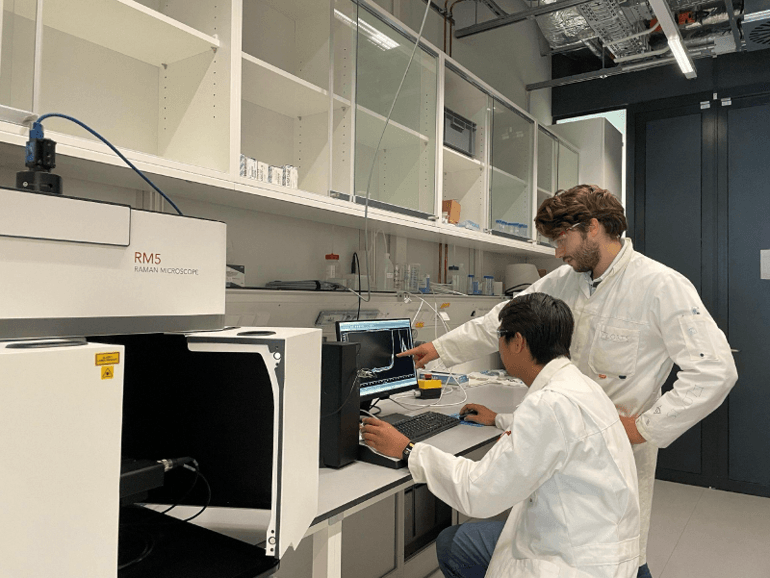
RM5 in use by the Morales group

Figure 2. Fika Fauzi and Floris van Lieshout performing measurements with the RM5.


The Edinburgh Instruments RM5 Raman Microscope is one of the key research tools in the Morales group (Figure 2). It is often used ex situ to characterise materials and to monitor how catalyst structures evolve over long periods of time under various conditions.

More importantly, the RM5 enables in‑situ measurements in combination with electrochemistry. An electrochemical cell is placed under the Raman microscope, allowing the team to monitor a catalyst immersed in an electrolyte while electrochemical reactions are running. Observing potential‑ and current‑dependent changes in the Raman signals lets the group “see” what happens at the interface during operation and understand exactly how the catalyst is working.

“The RM5 plays an important role in our research by allowing us to look beyond electrochemical performance and directly investigate what happens to our catalysts during operation. This allows us to understand why certain materials behave the way they do.”


Tracking catalyst reconstruction with Raman spectroscopy

Van Lieshout considers the RM5 his analytical workhorse. In recent work, he investigated how different electrolyte compositions affect the reconstruction of a cobalt‑based MOF catalyst1. Visible changes were observed in the catalyst layer of the electrodes after electrolysis, and Raman spectroscopy enabled the team to quantify these changes and correlate them with possible catalyst reconstruction (Figure 3).

These insights reveal how catalysts evolve over time, under operating conditions, providing the information needed to design electrodes that are both energy efficient and chemically selective.
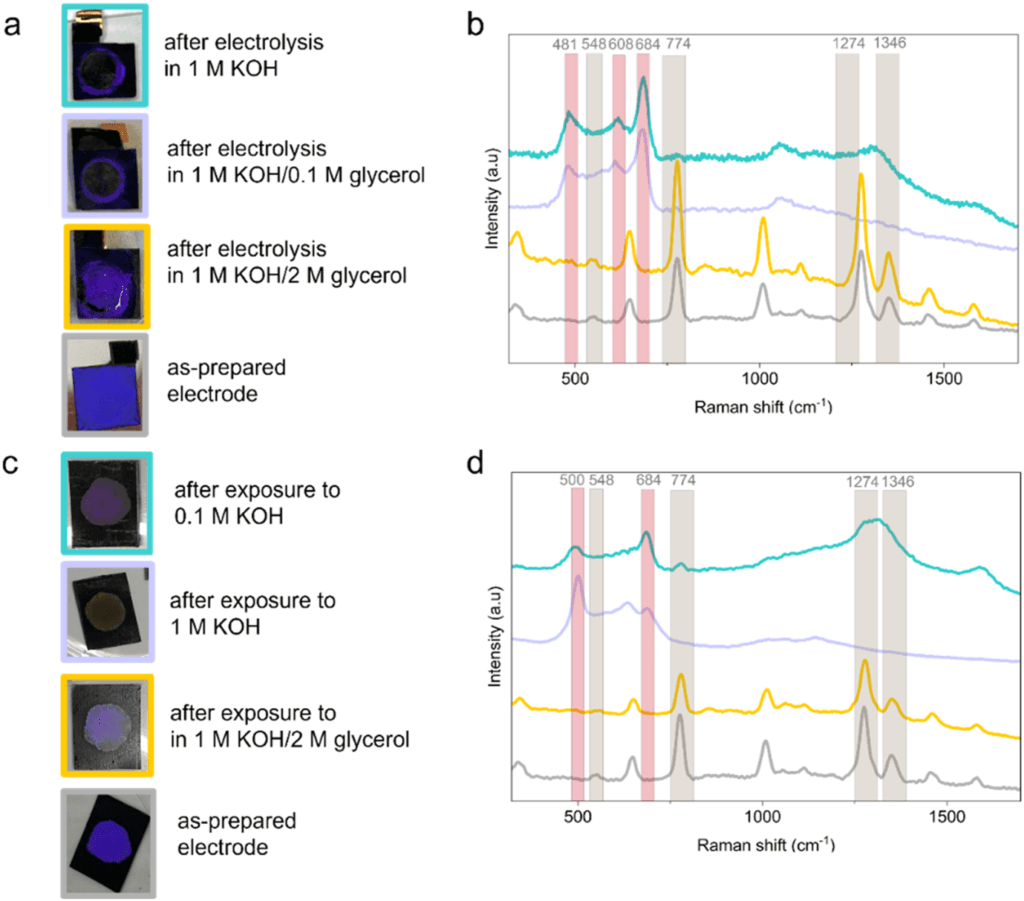
Photographs and Raman spectra of different electrodes
Figure 3. Photographs and Raman spectra of different electrodes, (top) after electrolysis and (bottom) after chemical exposure under different electrolyte conditions. Raman spectroscopy can visualise physical changes in the catalyst layer and track catalyst evolution over time. Figure adapted from ref. 1 under licence CC BY 4.0


Looking to the future: understanding electrochemical interfaces 

By looking beyond electrochemical performance to what happens at the catalyst during operation, the Morales group is building the understanding needed to steer alternative anode reactions such as the GOR towards both higher energy efficiency and greater chemical selectivity. In‑situ Raman spectroscopy with the RM5 will remain central to enabling this work. 

We look forward to seeing how Dr. Morales and her team continue to advance sustainable electrochemistry using the RM5.


The RM5 across the University of Groningen

The RM5 also supports research beyond the Morales group. In a recent collaborative study led by Dian Burhani and Prof. Katja Loos at the Zernike Institute for Advanced Materials, with Raman support from the Morales group, researchers investigated whether reusable plastic water bottles designed for toddlers release microplastics during everyday use.2 The bottles were stored for extended periods and subjected to mechanical stress that mimicked sipping through, and biting, the silicone straw, before the released particles were analysed.

Polypropylene microparticles, mostly 20–50 μm in size, were consistently released from the bottles, corresponding to an estimated daily intake of 1.2 ng/kg/day for toddlers aged 3–6 years after 100 sips. The RM5 was used to check whether the polydimethylsiloxane (PDMS) straws were also shedding particles: the Raman spectra of the filtered water samples matched the filter membrane rather than the straw material, showing that no PDMS was detected within the size range of the methods used. The findings suggest that toddlers’ ingestion of microplastics may be a routine part of everyday life rather than an incidental occurrence.

 

References 

  1. F. van Lieshout et al., Catal. Sci. Technol., 2026, 16, 6069-6085, DOI: https://doi.org/10.1039/d6cy00836d.
  2. D. Burhani et al., Environ. Pollut., 2026, 407, 128743, DOI: https://doi.org/10.1016/j.envpol.2026.128743.
Read More Read Less

RELATED PRODUCTS

RMS1000

Multimodal Confocal Microscope

VIEW

RM5

Raman Microscope

VIEW

Contact our expert team today to find out more about how our products can improve your research

Contact Us
PrevPrevious
Previous Exploring Quantum Colour Centres with Photoluminescence and g² Measurements

RESOURCES

Morales Group | University of Groningen
Tags:
  • Customer Application
  • Batteries and Fuel Cells
  • Energy
  • RM5
  • Raman
Customer Application
Download PDF
Featured Product:

RM5 Raman Microscope

View more »
Suggested Reading:

Raman Microscopy

View more »
Share:

Keep up to date with the latest from Edinburgh Instruments

Join our mailing list and keep up with our latest videos, app notes and more!

LOCATION:
  • Edinburgh Instruments Ltd.
    2 Bain Square, Kirkton Campus, Livingston, EH54 7DQ
  • sales@edinst.com
  • +44 1506 425 300
ABOUT:
  • About Edinburgh Instruments
  • Techniques
  • Applications
  • Knowledgebase
  • About Edinburgh Instruments
  • Techniques
  • Applications
  • Knowledgebase
PRODUCTS:
  • Fluorescence Spectrometers
  • Raman Microscopes
  • UV-Vis Spectrophotometers
  • Transient Absorption
  • FTIR Spectrometers
  • Lasers and LEDs
  • Customisation Options
  • Software
  • Upgrades
  • All Products
  • Fluorescence Spectrometers
  • Raman Microscopes
  • UV-Vis Spectrophotometers
  • Transient Absorption
  • FTIR Spectrometers
  • Lasers and LEDs
  • Customisation Options
  • Software
  • Upgrades
  • All Products
LEGALS:
  • News
  • Events
  • Blog
  • Careers
  • Distribution & Agents
  • Contact Us
  • Terms and Conditions
  • Privacy Policy
  • Coordinated Vulnerability Disclosure Policy
  • News
  • Events
  • Blog
  • Careers
  • Distribution & Agents
  • Contact Us
  • Terms and Conditions
  • Privacy Policy
  • Coordinated Vulnerability Disclosure Policy
SOCIALS:
Youtube Linkedin X-twitter Facebook
©2026 Edinburgh Instruments. Registered in England and Wales No: 962331. VAT No: GB 271 7379 37
Manage Consent
To provide the best experiences, we use technologies like cookies to store and/or access device information. Consenting to these technologies will allow us to process data such as browsing behaviour or unique IDs on this site. Not consenting or withdrawing consent, may adversely affect certain features and functions.
Functional Always active
The technical storage or access is strictly necessary for the legitimate purpose of enabling the use of a specific service explicitly requested by the subscriber or user, or for the sole purpose of carrying out the transmission of a communication over an electronic communications network.
Preferences
The technical storage or access is necessary for the legitimate purpose of storing preferences that are not requested by the subscriber or user.
Statistics
The technical storage or access that is used exclusively for statistical purposes. The technical storage or access that is used exclusively for anonymous statistical purposes. Without a subpoena, voluntary compliance on the part of your Internet Service Provider, or additional records from a third party, information stored or retrieved for this purpose alone cannot usually be used to identify you.
Marketing
The technical storage or access is required to create user profiles to send advertising, or to track the user on a website or across several websites for similar marketing purposes.
  • Manage options
  • Manage services
  • Manage {vendor_count} vendors
  • Read more about these purposes
View preferences
  • {title}
  • {title}
  • {title}