Improving photovoltaic materials is about more than measuring the final efficiency of a solar cell. Understanding why a device performs as it does requires insight into the fundamental processes taking place inside the active layer, from light absorption and charge separation to recombination and charge extraction.
In this Edinburgh Instruments webinar, Grant Cumming explores how steady-state and time-resolved PL spectroscopy, PLQY, and imaging techniques can uncover these processes and help researchers characterise photovoltaic materials earlier in the development process.
Photoluminescence (PL) provides a straightforward window into the electronic properties of photovoltaic materials. Following photoexcitation, electrons relax and can recombine radiatively, producing PL emission. In a photovoltaic material, the energy of this emission can provide information about the bandgap.
PL can also reveal how material properties change under different conditions. For example, variable-temperature measurements can track changes in the PL spectrum of perovskites, allowing temperature-dependent phase transitions to be identified through changes in bandgap.
PLQY is defined as the ratio of emitted to absorbed photons and, in photovoltaic materials, reflects the balance between radiative and non-radiative recombination. High PLQY in precursor photovoltaic materials indicates fewer non-radiative energy-loss pathways, and relates directly to the maximum achievable open-circuit voltage.
For thin films and other solid samples, absolute PLQY can be measured using an integrating sphere, which removes much of the positional and directional dependence associated with conventional relative PL measurements.
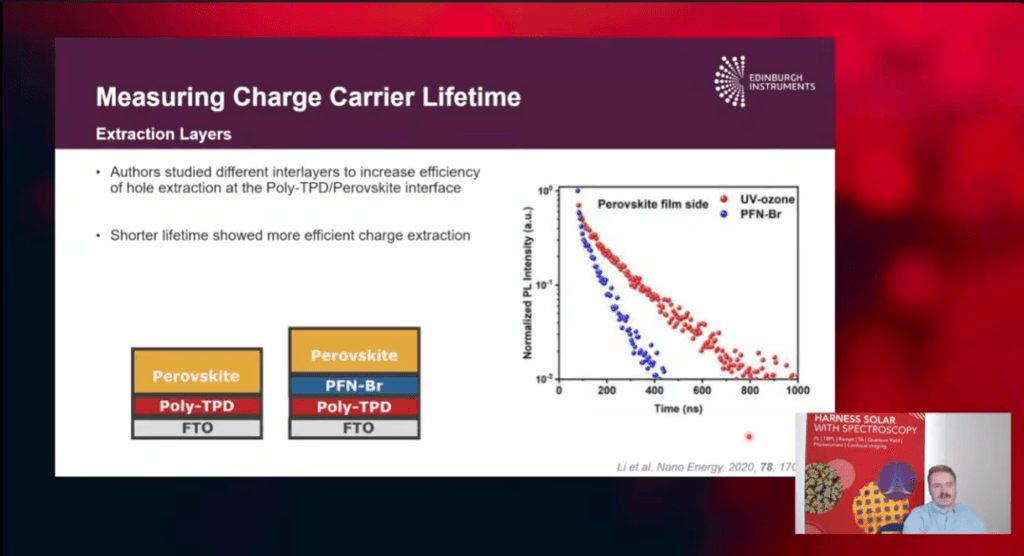
While steady-state spectroscopy reveals what is happening, time-resolved PL adds another dimension by showing how quickly it happens. Charge-carrier lifetime measurements can therefore help researchers investigate processing conditions and charge-extraction layers.
The webinar shows how lifetime measurements revealed changes associated with annealing time in MAPI perovskites, and how shorter lifetimes at an extraction interface could indicate more efficient charge extraction.
Photovoltaic materials are rarely perfectly homogeneous, making spatially resolved measurements particularly valuable. By coupling PL spectroscopy to microscopy, researchers can map spectra or lifetime decays across a sample and identify local variations in charge-carrier behaviour.
Taking this further, multimodal Raman, PL, and photocurrent imaging can connect material composition, optical behaviour and electrical performance. In the PM6:Y6 example presented in the webinar, regions of high PL corresponded with poor photocurrent, while Raman measurements provided complementary information about the active-layer composition.
Watch the full webinar to hear Grant Cumming showcase how optical spectroscopy can reveal the inner workings of photovoltaic materials, uncover efficiency-limiting processes, and support more informed solar-cell development.