Choosing the best Raman microscope for your research requires careful consideration. A Raman microscope is a significant investment for your lab, so it is important to understand which features will best support your current requirements and adapt with your future goals.
We know this can be a difficult decision. To make it easier, we have created this guide to highlight nine key features to consider when choosing your Raman microscope. We have also included a simple comparison table showing how the Edinburgh Instruments RM5 and RMS1000 compare with alternative products, giving you a clear overview of capabilities our systems offer.
Excitation Sources
Consider both the samples you analyse today and those you may encounter in the future. Some materials benefit from shorter wavelengths for maximum Raman efficiency, while others require longer wavelengths to minimise fluorescence.
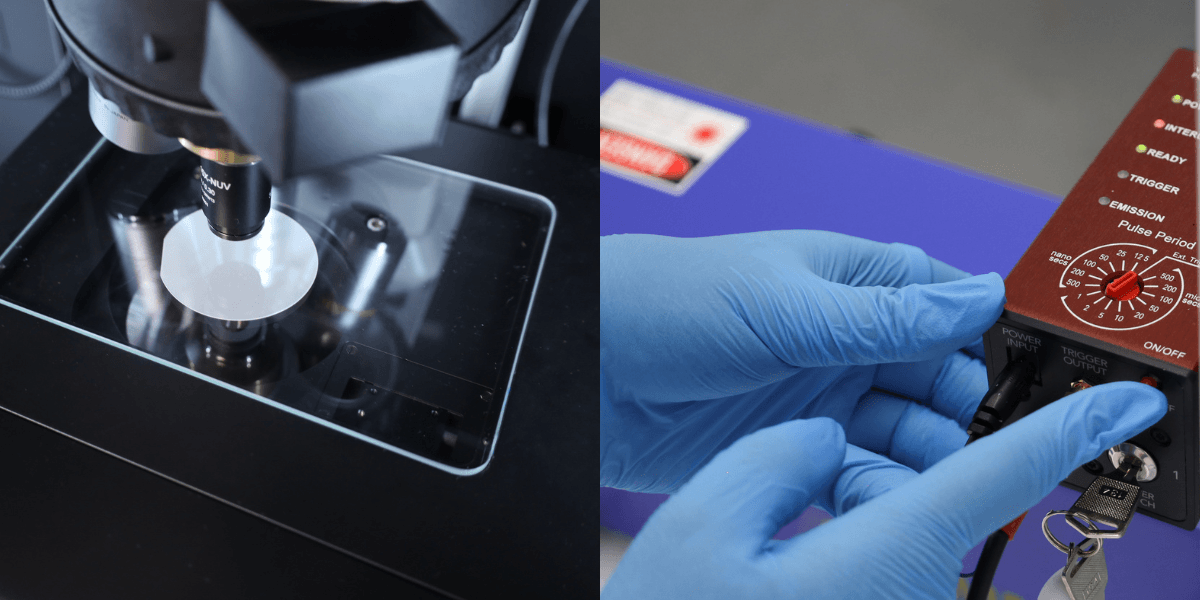
Modern Raman systems are available with excitation wavelengths ranging from UV through visible to near-infrared. Systems supporting multiple lasers provide the flexibility to tackle a wider range of materials and applications.
For most Raman laboratories, a combination of 532 nm and 785 nm provides excellent coverage. 532 nm offers strong Raman scattering, while 785 nm helps minimise fluorescence in challenging samples.
Coupling
The way laser light is coupled into the microscope influences system stability, optical performance, throughput, and upgrade potential.
Raman microscopes typically use either fibre-coupled or free-space optical designs. Free-space optical paths maximise optical throughput, preserve beam quality, and offer greater flexibility for integrating multiple lasers and advanced measurement techniques.
For research applications requiring the highest optical efficiency and long-term expandability, a well-designed free-space optical architecture offers significant advantages.
Confocality
The level of confocal control can vary significantly between Raman microscopes. Consider how easily confocal settings can be adjusted to balance spatial resolution, signal intensity, and experimental requirements.
Not all confocal Raman systems are truly confocal. Some achieve confocality through a fixed collection fibre or fixed optical apertures, limiting optimisation. Systems with independently adjustable confocal components allow users to tailor performance for either maximum signal throughput or maximum spatial discrimination.
For research applications, look for a fully confocal system with adjustable apertures that can be optimised for different sample types and measurements.
Gratings
Some applications require high spectral resolution, while others benefit from measuring a larger spectral range in a single acquisition.
Higher groove density gratings deliver increased spectral resolution, while lower groove density gratings provide wider spectral coverage. Systems with multiple gratings offer the greatest flexibility.
A system with several automated gratings typically provides the best balance of resolution, spectral range, and ease of use.
Spectrograph
Spectrographs differ in focal length, optical design, and configuration options. Larger focal lengths generally deliver higher spectral resolution, while different optical designs balance resolution, throughput, and spectral coverage.
Choose a spectrograph that can support your most demanding applications, not just your immediate requirements. Systems with multiple spectrographs can provide access to both high-resolution and high-throughput measurements without compromise.
Detectors
Detector choice influences sensitivity, acquisition speed, spectral range, and overall measurement capability. It often determines how quickly and effectively high-quality data can be collected.
A back-illuminated CCD is often the best all-round detector for Raman spectroscopy. However, specialised applications may benefit from other detector technologies, making detector flexibility a valuable consideration.
Software and Automation
Software platforms range from simple acquisition packages to comprehensive environments supporting automation, advanced analysis, and multimodal workflows.
Look for features such as guided workflows, automated optimisation, mapping tools, and support for future techniques. The best software combines intuitive operation for new users with powerful tools for experienced researchers.
Footprint
Laboratory space is often limited, making instrument footprint an important consideration. Modern Raman microscopes are increasingly designed with the space constraints of contemporary research laboratories in mind, integrating lasers and optical components within the instrument wherever possible.
Integrated designs minimise bench space requirements while improving ease of use, reliability, and day-to-day operation through full software control and reduced user intervention.
Future-Proofing
Research priorities evolve over time, and a Raman microscope should be capable of evolving with them.
Consider potential future requirements such as additional laser wavelengths, detectors, imaging capabilities, photoluminescence, FLIM, environmental control, or other advanced techniques. A flexible, modular platform can protect your investment and extend the useful lifetime of the system.
| Specification | RM5 Raman Microscope | RMS1000 Multimodal Microscope | Common Specification |
|---|---|---|---|
| Excitation Source | Up to 3 internal lasers (405-1064 nm), computer controlled | Up to 5 internal lasers (405-1064 nm), computer controlled | From 2–5, often not all internal or not fully computer controlled |
| Coupling | Free-space | Free-space | Mix of free space and fibre coupling |
| Confocality | True confocal with physical pinhole | True confocal with physical pinhole | Pseudo confocal, or confocal with limited pinhole choice |
| Gratings | Up to 5, fully automated | Up to 5, fully automated | Typically 2–3, often with manual exchange required |
| Spectrograph Options | 225 mm, mirror-based | 225 mm, mirror-based and/or 800 mm | Mixed designs; some systems limited by laser path length. 800 mm only available from very few suppliers |
| Footprint | Compact, consistent footprint even with upgrades | Narrow width & depth; vertically mounted optics reduce bench impact | Frequently large, often requiring deeper or customised benches; footprint increases with add-ons |
| Detectors | Up to 2 | Up to 4 | 1–2 on mid range, up to 2–4 on high end, often requiring larger external modules |
| Software | Ramacle – all controlled in one interface, most features included as standard. | Ramacle– all controlled in one interface, most features included as standard. Extended features for advanced modules; seamless technique switching. | Typically requires multiple software packages or paid add‑ons for extended functionality |
| Future Proofing | Modular but compact; supports multiple lasers, detectors, and standard Raman workflows | Fully modular with support for fluorescence lifetime, SHG, two‑photon FLIM, and external laser integration. FLIM upgrade all EI’s development. | Many systems require third‑party add‑ons or separate instruments for advanced techniques. |
For further details about our Raman microscopes, visit the RM5 and RMS1000 product pages. There, you will find full specifications, measurement examples, and information on the options that allow each system to be tailored to your research needs.
If you would like to discuss your specific requirements, contact our team of Raman experts. They can help you identify the best configuration of your Raman microscope for your research and answer any questions about how our systems can support your work.