Skip to content
  • News
  • Events
  • eBooks
  • Blog
  • Careers
  • Contact
  • News
  • Events
  • eBooks
  • Blog
  • Careers
  • Contact
KNOWLEDGEBASE
  • About Us
  • Products

    Fluorescence Spectrometers:

    • FLS1000 Photoluminescence Spectrometer
    • FS5 Spectrofluorometer
    • LifeSpec II Lifetime Spectrometer
    • Mini-tau Lifetime Spectrometer

    Raman Microscopes:

    • RM5 Raman Microscope
    • RMS1000 Multimodal Confocal Microscope

    Transient Absorption:

    • LP980 Transient Absorption Spectrometer

    FTIR Spectrometers:

    • IR5 FTIR Spectrometer

    Lasers and LEDs:

    • Pulsed Lasers
    • Gas Lasers

    Options:

    • Upgrades
    • Customisation
    View All Products
  • Techniques
  • Applications
KNOWLEDGEBASE
Edit Content
  • About Edinburgh Instruments
  • Products
  • Techniques
  • Applications
  • Knowledgebase
  • eBooks
  • News
  • Events
  • Blog
  • Careers
  • Contact Us

RESOURCES

Radioluminescence for Quality Control of Perovskites 

  • February 9, 2026

KEY POINTS

  • Metal-halide perovskites such as crystalline CsPbBr3 are seen as the next generation of X-ray detectors due to their low production costs and wide dynamic range.
  • However, a key challenge for these materials is achieving crystals of sufficient quality for sensitive radiation detection.
  • We highlight research from the University of Cambridge, where the authors used an Edinburgh Instruments FLS1000 Photoluminescence Spectrometer equipped with the XS1 Radioluminescence chamber to assess the quality of CsPbBr3 crystals in the detection of X-rays.
Edit Content

Detection of ionising radiation such as X-rays and γ-rays is important for many applications such as medical imaging, homeland security, and for high-energy physics research. Metal-halide perovskites such as CsPbBr3 have become increasingly popular materials for X-ray detection due to their low production cost, high sensitivity across a wide range of photon energies (200 – 500 keV), and their ability to operate at room temperature.  

One of the biggest hurdles for commercialisation of perovskites for this application is achieving high quality bulk crystals as this is the primary factor influencing detector performance. High quality crystals exhibit large vertical diffusion coefficients and long carrier lifetimes which are critical for efficient charge collection.  

We highlight work published in Advanced Materials from Professor Samuel Stranks and co-workers at the University of Cambridge.1 In this work, the authors used radioluminescence (RL) spectroscopy to assess the quality of CsPbBr3 crystals for detection of ionising radiation.  

In order to be confident that the RL measurements were a reliable indicator of crystal quality, high-performance, research-grade instrumentation was required. RL measurements were performed on an Edinburgh Instruments FLS1000 Photoluminescence Spectrometer equipped with the XS1 RL chamber (Figure 1). The chamber couples to the FLS1000 via a liquid light guide and is compatible with both continuous wave (CW) and pulsed X-ray sources. 


Figure 1: Schematic of an FLS1000 Photoluminescence Spectrometer coupled to an XS1 RL chamber for spectral measurements.

Methods and Materials 

CsPbBr3 single crystal of different qualities were synthesised at different grow rates: low quality (3 mm h-1), high quality A (2 mm h-1), and high quality B (1 mm h-1). Crystal quality was also assessed by their dark counts and γ-ray response as a working detector. RL measurements were performed in an Edinburgh Instruments XS1 coupled to an FLS1000.  

Single crystals of varying quality were loaded into the XS1 chamber and were irradiated by an X-ray source with voltage and current set at 60 kV 200 µA, 40 kV 300 µA, or 20 kV 600 µA, for a total of 12 W in each case. X-ray sources provided with the XS1 allow for easy adjustment of voltage and current using software control. Emission was detected on a PMT-980, providing spectral coverage up to 950 nm.  

Results 

Under irradiation, each of the crystals exhibited emission bands centred at ~550 nm (Figure 2). With the X-ray source operating at 60 kV, 200 µA, the sample with the slowest crystal growth rate, high quality B, produced the most intense signal of the three (Figure 1a). However, at 40 kV, 300 µA, and 20 kV, 600 µA, high quality A crystals produced the most intense signal (Figure 1b, c). While it may have been assumed that slower growth rates would produce higher quality, more strongly emitting crystals, this was not the case. The picture is more complex, showing emission is also dependent on the voltage and current of the source.  

Radioluminescence of perovskite crystals of varying quality.

Figure 2: RL emission spectra of CsPbBr3 crystals of varying quality measured with X-ray source operating at (a) 60 kV 200 µA, (b) 40 kV 300 µA, and (c) 20 kV 600 µA. Figure reprinted with permission from Stranks et al. 1

Conclusions 

This Research Highlight has demonstrated how the FLS1000 coupled to the XS1 may be used to assess the quality of perovskite crystals using RL spectroscopy. The tuneable X-ray source allowed the team to investigate the optimal voltage and current for each sample, providing valuable information about sample quality. Furthermore, the high sensitivity of the FLS1000 allowed the authors to observe weak signals and detect subtle changes in radioluminescence intensity at different source conditions. 

Full Publication 

The article was published in Advanced Materials and is available at: DOI:10.1002/adma.202512302 

References 

  1. S. D. Stranks et al., Advanced Materials, 2025, e12302, DOI:10.1002/adma.202512302 

RELATED PRODUCTS

XS1

X-Ray Radioluminescence Chamber

VIEW

FLS1000

Photoluminescence Spectrometer

VIEW

Contact our expert team today to find out more about how our products can improve your research

Contact Us
PrevPrevious
Previous Plasmonic-Upconverting Nanosensors Enable Rapid Optical Detection of Toxic Mercury Ions

RESOURCES

Tags:
  • Research Highlight
  • Scintillators
  • FLS1000
  • XS1
  • Photoluminescence
Featured Product:

XS1

View more »
Suggested Reading:
copper cluster scintillators

Photo- and Radio-Luminescence of Copper Cluster Scintillators

View more »
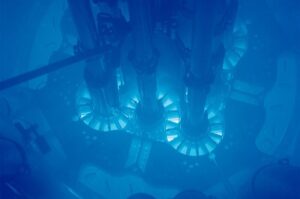
Emission of blue Cherenkov radiation from an underwater nuclear reactor at the Idaho National Laboratory. Credit: Argonne National Lab, reproduced under CC-2.0 licence.

What is Radioluminescence?

View more »

Time-Resolved Radioluminescence of Perovskite Scintillators

View more »
Share:

Keep up to date with the latest from Edinburgh Instruments

Join our mailing list and keep up with our latest videos, app notes and more!

LOCATION:
  • Edinburgh Instruments Ltd.
    2 Bain Square, Kirkton Campus, Livingston, EH54 7DQ.
  • sales@edinst.com
  • +44 1506 425 300
ABOUT:
  • About Edinburgh Instruments
  • Techniques
  • Applications
  • Knowledgebase
  • About Edinburgh Instruments
  • Techniques
  • Applications
  • Knowledgebase
PRODUCTS:
  • Fluorescence Spectrometers
  • Raman Microscopes
  • UV-Vis Spectrophotometers
  • Transient Absorption
  • FTIR Spectrometers
  • Lasers and LEDs
  • Customisation Options
  • Software
  • Upgrades
  • All Products
  • Fluorescence Spectrometers
  • Raman Microscopes
  • UV-Vis Spectrophotometers
  • Transient Absorption
  • FTIR Spectrometers
  • Lasers and LEDs
  • Customisation Options
  • Software
  • Upgrades
  • All Products
LEGALS:
  • News
  • Events
  • Blog
  • Careers
  • Contact Us
  • Terms and Conditions
  • Privacy Policy
  • News
  • Events
  • Blog
  • Careers
  • Contact Us
  • Terms and Conditions
  • Privacy Policy
SOCIALS:
Youtube Linkedin X-twitter Facebook
©2024 Edinburgh Instruments. Registered in England and Wales No: 962331. VAT No: GB 271 7379 37
Manage Consent
To provide the best experiences, we use technologies like cookies to store and/or access device information. Consenting to these technologies will allow us to process data such as browsing behaviour or unique IDs on this site. Not consenting or withdrawing consent, may adversely affect certain features and functions.
Functional Always active
The technical storage or access is strictly necessary for the legitimate purpose of enabling the use of a specific service explicitly requested by the subscriber or user, or for the sole purpose of carrying out the transmission of a communication over an electronic communications network.
Preferences
The technical storage or access is necessary for the legitimate purpose of storing preferences that are not requested by the subscriber or user.
Statistics
The technical storage or access that is used exclusively for statistical purposes. The technical storage or access that is used exclusively for anonymous statistical purposes. Without a subpoena, voluntary compliance on the part of your Internet Service Provider, or additional records from a third party, information stored or retrieved for this purpose alone cannot usually be used to identify you.
Marketing
The technical storage or access is required to create user profiles to send advertising, or to track the user on a website or across several websites for similar marketing purposes.
  • Manage options
  • Manage services
  • Manage {vendor_count} vendors
  • Read more about these purposes
View preferences
  • {title}
  • {title}
  • {title}