
Skip to content
  • News
  • Events
  • eBooks
  • Blog
  • Careers
  • Contact
  • News
  • Events
  • eBooks
  • Blog
  • Careers
  • Contact
KNOWLEDGEBASE
  • About Us
  • Products

    Fluorescence Spectrometers:

    • FLS1000 Photoluminescence Spectrometer
    • FS5 Spectrofluorometer
    • LifeSpec II Lifetime Spectrometer
    • Mini-tau Lifetime Spectrometer

    Raman Microscopes:

    • RM5 Raman Microscope
    • RMS1000 Multimodal Confocal Microscope

    Transient Absorption:

    • LP980 Transient Absorption Spectrometer

    FTIR Spectrometers:

    • IR5 FTIR Spectrometer

    Lasers and LEDs:

    • Pulsed Lasers
    • Gas Lasers

    Options:

    • Upgrades
    • Customisation
    View All Products
  • Techniques
  • Applications
KNOWLEDGEBASE
  • About Edinburgh Instruments
  • Products
  • Techniques
  • Applications Old
  • Knowledgebase
  • eBooks
  • News
  • Events
  • Blog
  • Careers
  • Contact Us

RESOURCES

Photonic Upconversion Nanoparticles for Biological Applications

  • April 29, 2026

KEY POINTS

  • Upconversion nanoparticles (UCNPs) absorb two or more lower-energy photons and emit a higher-energy photon, offering unique possibilities for imaging and sensing.
  • Near-infrared excitation makes UCNPs particularly interesting for biological applications, including deep-tissue imaging, biosensing and light-activated therapeutics.
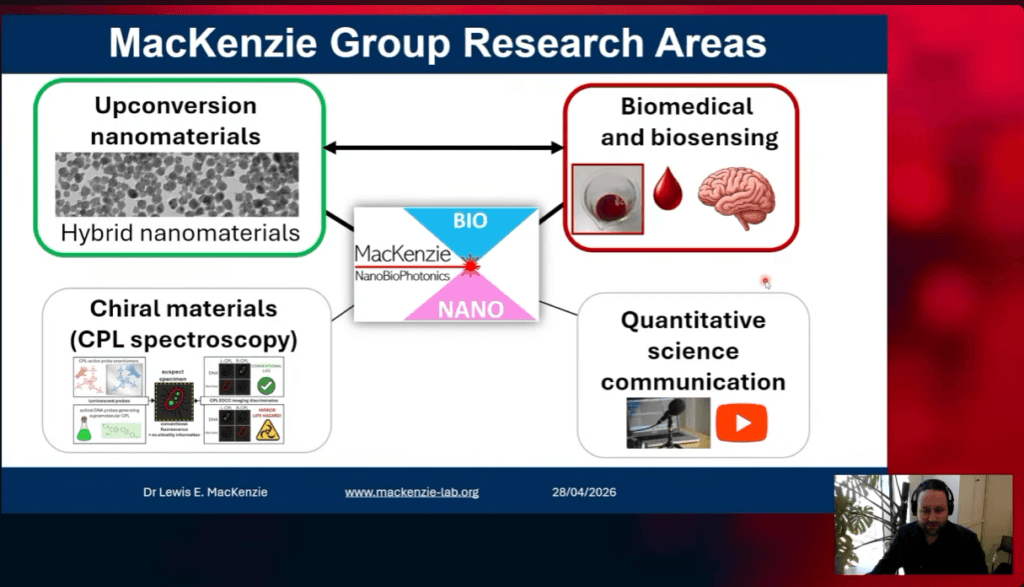
  • The MacKenzie Group is developing UCNPs for applications including non-invasive oxygen sensing and targeted glioblastoma therapies, supported by advanced photoluminescence spectroscopy.

Upconversion nanoparticles are unusual optical materials capable of turning lower-energy excitation light into higher-energy emission. Their distinctive lanthanide photophysics, tunable emission and compatibility with near-infrared excitation have opened opportunities across sensing, imaging and biomedicine.

In this Edinburgh Instruments webinar, Dr Lewis E. MacKenzie from the University of Strathclyde explores the photophysics of upconversion nanoparticles and their emerging biological applications, from temperature and force sensing to deep-tissue imaging and light-activated therapeutics.


What Are Upconversion Nanoparticles?

At its simplest, photonic upconversion involves absorbing two or more photons before emitting one higher-energy photon. UCNPs typically exploit lanthanide ions, with combinations such as Yb³⁺ and Er³⁺ providing absorption and emission pathways. Changing the dopants and nanoparticle architecture enables emission to be tuned across different wavelengths.

The long-lived excited states and characteristic emission of lanthanides make these materials particularly versatile, while near-infrared excitation wavelengths such as 808, 976 and 1550 nm can access spectral regions where tissue absorption is reduced.


From Imaging to Sensing

The range of potential UCNP applications is remarkably broad. The webinar highlights their use in temperature sensing, force measurements, tracking labelled microplastics, multimodal MRI probes and deep-tissue biological imaging.

In biomedical research, their properties are also being investigated for technologies including light-activated drug release and deep-tissue optogenetics.


Developing UCNPs for Biological Oxygen Sensing

The MacKenzie Group is investigating whether red-emitting UCNPs can provide a route towards non-invasive biological oxygen sensing. Optimising nanoparticle brightness is critical: work presented in the webinar shows that PEI polymer molecular weight affects UCNP photophysics, with an approximately five-fold increase in brightness reported for the studied formulation.

Measurements using the Edinburgh Instruments FS5 Spectrofluorometer also showed that modified UCNPs retain detectable red luminescence in whole blood in preliminary experiments. Lifetime measurements further help researchers investigate quenching and confirm FRET processes relevant to the proposed sensing mechanism.


Towards New Biomedical Applications

The research extends beyond sensing. The MacKenzie Group is also exploring UCNPs as part of a strategy to “track and treat” glioblastoma, including approaches for targeting and delivering established anti-tumour drugs.

Together, these examples demonstrate how careful control of nanoparticle composition, surface chemistry and photophysics can transform upconversion from a fascinating optical phenomenon into a platform for advanced biological research. The webinar concludes that the Edinburgh Instruments FS5 Spectrofluorometer can be used to investigate upconversion processes in detail, including measurements in blood.


Watch the Upconversion Nanoparticles Webinar

Watch the full webinar to hear Dr Lewis E. MacKenzie explore how photonic upconversion works, discover cutting-edge applications of UCNPs, and see how advanced photoluminescence spectroscopy is supporting the development of new approaches to biological sensing, imaging and therapeutics.
Read More Read Less

RELATED PRODUCTS

FS5

Spectrofluorometer

VIEW

Contact our expert team today to find out more about how our products can improve your research

Contact Us
PrevPrevious
NextNext
Previous Choosing Detectors for your FLS1000 Photoluminescence Spectrometer Next Ramacle® – Cosmic Ray Removal

RESOURCES

Upconversion Nanoparticles Webinar Featured Image
Tags:
  • Webinars
  • Biomedical
  • Lanthanides
  • Upconversion
  • FS5
  • Photoluminescence
Featured Product:
FS5 Spectrofluorometer

FS5 Spectrofluorometer

View more »
Suggested Reading:
Close up of nano particles

Spectra, Lifetime and Quantum Yield of Upconversion Nanoparticles

View more »

Lanthanide Based Upconversion Materials

View more »
Share:

Keep up to date with the latest from Edinburgh Instruments

Join our mailing list and keep up with our latest videos, app notes and more!

LOCATION:
  • Edinburgh Instruments Ltd.
    2 Bain Square, Kirkton Campus, Livingston, EH54 7DQ
  • sales@edinst.com
  • +44 1506 425 300
ABOUT:
  • About Edinburgh Instruments
  • Techniques
  • Applications
  • Knowledgebase
  • About Edinburgh Instruments
  • Techniques
  • Applications
  • Knowledgebase
PRODUCTS:
  • Fluorescence Spectrometers
  • Raman Microscopes
  • UV-Vis Spectrophotometers
  • Transient Absorption
  • FTIR Spectrometers
  • Lasers and LEDs
  • Customisation Options
  • Software
  • Upgrades
  • All Products
  • Fluorescence Spectrometers
  • Raman Microscopes
  • UV-Vis Spectrophotometers
  • Transient Absorption
  • FTIR Spectrometers
  • Lasers and LEDs
  • Customisation Options
  • Software
  • Upgrades
  • All Products
LEGALS:
  • News
  • Events
  • Blog
  • Careers
  • Distribution & Agents
  • Contact Us
  • Terms and Conditions
  • Privacy Policy
  • Coordinated Vulnerability Disclosure Policy
  • News
  • Events
  • Blog
  • Careers
  • Distribution & Agents
  • Contact Us
  • Terms and Conditions
  • Privacy Policy
  • Coordinated Vulnerability Disclosure Policy
SOCIALS:
Youtube Linkedin X-twitter Facebook
©2026 Edinburgh Instruments. Registered in England and Wales No: 962331. VAT No: GB 271 7379 37
Manage Consent
To provide the best experiences, we use technologies like cookies to store and/or access device information. Consenting to these technologies will allow us to process data such as browsing behaviour or unique IDs on this site. Not consenting or withdrawing consent, may adversely affect certain features and functions.
Functional Always active
The technical storage or access is strictly necessary for the legitimate purpose of enabling the use of a specific service explicitly requested by the subscriber or user, or for the sole purpose of carrying out the transmission of a communication over an electronic communications network.
Preferences
The technical storage or access is necessary for the legitimate purpose of storing preferences that are not requested by the subscriber or user.
Statistics
The technical storage or access that is used exclusively for statistical purposes. The technical storage or access that is used exclusively for anonymous statistical purposes. Without a subpoena, voluntary compliance on the part of your Internet Service Provider, or additional records from a third party, information stored or retrieved for this purpose alone cannot usually be used to identify you.
Marketing
The technical storage or access is required to create user profiles to send advertising, or to track the user on a website or across several websites for similar marketing purposes.
  • Manage options
  • Manage services
  • Manage {vendor_count} vendors
  • Read more about these purposes
View preferences
  • {title}
  • {title}
  • {title}