
Fluorescent probes allow researchers to visualise specific targets within biological samples by absorbing light at one wavelength and emitting fluorescence at another. From proteins and antibodies to nucleic acids and cellular structures, their effectiveness depends strongly on their photophysical properties.
In this Edinburgh Instruments webinar, Maria Tesa and Tommy Loan explore the spectroscopy of fluorescent probes, using perovskite quantum dots to demonstrate how absorption, fluorescence emission, photoluminescence lifetime and photoluminescence quantum yield (PLQY) can provide a complete picture of probe performance.
For bioimaging, an ideal fluorescent probe combines specificity, high brightness, photostability, a large Stokes shift and biocompatibility, alongside excitation and emission wavelengths suited to the application. Red and near-infrared emission can help reduce biological autofluorescence, while avoiding UV excitation can minimise tissue damage.
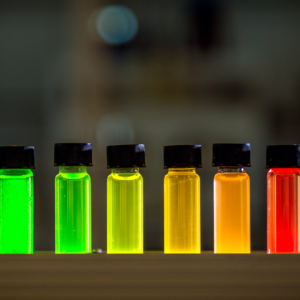
Perovskite quantum dots are particularly interesting because their optical properties can be controlled through their size. Quantum confinement changes their bandgap as particle size changes, providing a route to tune their absorption and photoluminescence wavelengths.
Absorption spectroscopy identifies where a probe absorbs and helps select an appropriate excitation wavelength, while its fluorescence emission spectrum determines the wavelengths at which its emission can be imaged.
In the webinar demonstration, the perovskite quantum dots produce a narrow fluorescence peak centred around 525 nm. Comparison with the absorption spectrum shows that this emission occurs at the quantum-dot band edge, while a tail in the absorption spectrum indicates the presence of defects and trapping sites.
Photoluminescence lifetime adds the time dimension. It provides information on recombination dynamics and the radiative and non-radiative relaxation pathways within a fluorescent probe. The webinar introduces time-correlated single photon counting (TCSPC) for lifetime measurements and demonstrates a measured intensity-weighted average lifetime of 16 ns for the quantum-dot sample.
PLQY measures the efficiency of light emission by comparing the number of photons emitted with the number absorbed. Using an integrating sphere measurement, the demonstrated perovskite quantum dots were found to have a PLQY of just over 5%.
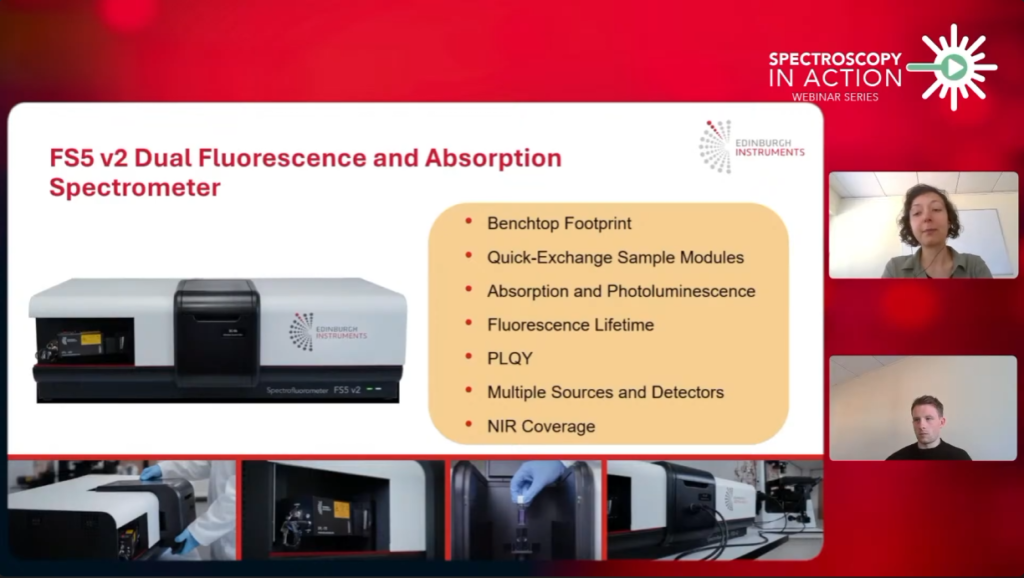
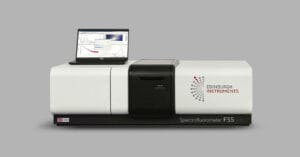
A key advantage of the Edinburgh Instruments FS5 v2 Spectrofluorometer is that absorption, fluorescence spectra, lifetime and quantum yield can all be measured on a single platform. This reduces the need to move between different experimental setups and enables researchers to screen fluorescent probes efficiently.
Watch the full webinar to see Maria Tesa and Tommy Loan demonstrate how absorption and photoluminescence spectroscopy can be combined to characterise fluorescent probes for bioimaging. Follow the experimental workflow for measuring the absorption spectrum, fluorescence emission, PL lifetime and quantum yield of perovskite quantum dots using the FS5 v2 Spectrofluorometer.