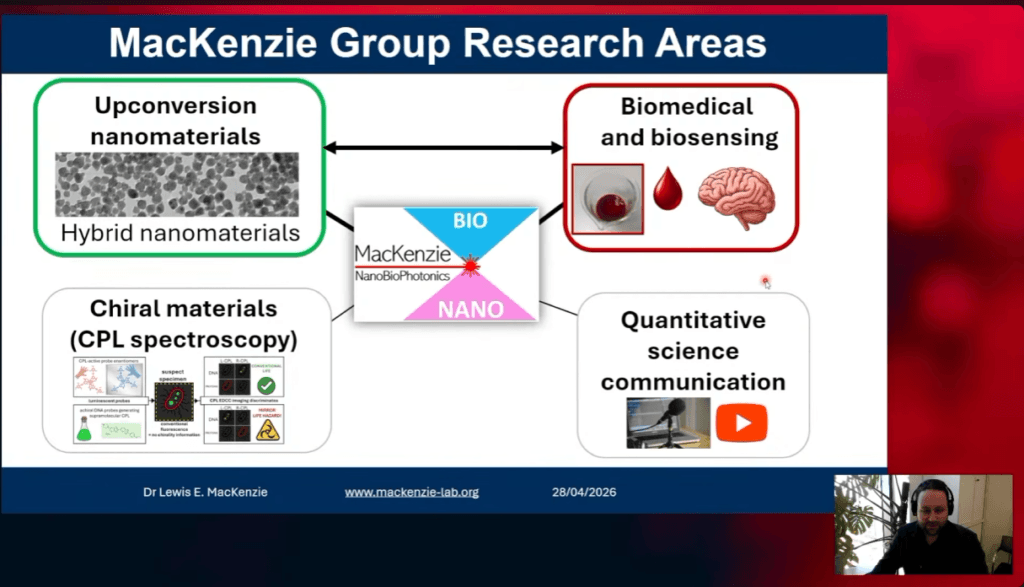
Upconversion nanoparticles are unusual optical materials capable of turning lower-energy excitation light into higher-energy emission. Their distinctive lanthanide photophysics, tunable emission and compatibility with near-infrared excitation have opened opportunities across sensing, imaging and biomedicine.
In this Edinburgh Instruments webinar, Dr Lewis E. MacKenzie from the University of Strathclyde explores the photophysics of upconversion nanoparticles and their emerging biological applications, from temperature and force sensing to deep-tissue imaging and light-activated therapeutics.
At its simplest, photonic upconversion involves absorbing two or more photons before emitting one higher-energy photon. UCNPs typically exploit lanthanide ions, with combinations such as Yb³⁺ and Er³⁺ providing absorption and emission pathways. Changing the dopants and nanoparticle architecture enables emission to be tuned across different wavelengths.
The long-lived excited states and characteristic emission of lanthanides make these materials particularly versatile, while near-infrared excitation wavelengths such as 808, 976 and 1550 nm can access spectral regions where tissue absorption is reduced.
The range of potential UCNP applications is remarkably broad. The webinar highlights their use in temperature sensing, force measurements, tracking labelled microplastics, multimodal MRI probes and deep-tissue biological imaging.
In biomedical research, their properties are also being investigated for technologies including light-activated drug release and deep-tissue optogenetics.
The MacKenzie Group is investigating whether red-emitting UCNPs can provide a route towards non-invasive biological oxygen sensing. Optimising nanoparticle brightness is critical: work presented in the webinar shows that PEI polymer molecular weight affects UCNP photophysics, with an approximately five-fold increase in brightness reported for the studied formulation.
Measurements using the Edinburgh Instruments FS5 Spectrofluorometer also showed that modified UCNPs retain detectable red luminescence in whole blood in preliminary experiments. Lifetime measurements further help researchers investigate quenching and confirm FRET processes relevant to the proposed sensing mechanism.
The research extends beyond sensing. The MacKenzie Group is also exploring UCNPs as part of a strategy to “track and treat” glioblastoma, including approaches for targeting and delivering established anti-tumour drugs.
Together, these examples demonstrate how careful control of nanoparticle composition, surface chemistry and photophysics can transform upconversion from a fascinating optical phenomenon into a platform for advanced biological research. The webinar concludes that the Edinburgh Instruments FS5 Spectrofluorometer can be used to investigate upconversion processes in detail, including measurements in blood.
Watch the full webinar to hear Dr Lewis E. MacKenzie explore how photonic upconversion works, discover cutting-edge applications of UCNPs, and see how advanced photoluminescence spectroscopy is supporting the development of new approaches to biological sensing, imaging and therapeutics.