Welcome to Edinburgh Instruments’ blog, celebrating our work in Raman, Photoluminescence, and Fluorescence Lifetime Imaging. Every month, we aim to highlight our pick for Map of the Month to show how our Raman and fluorescence spectrometers can be used to reveal all the hidden secrets in your samples.
December 2025
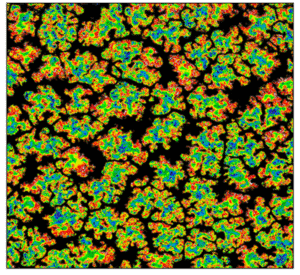
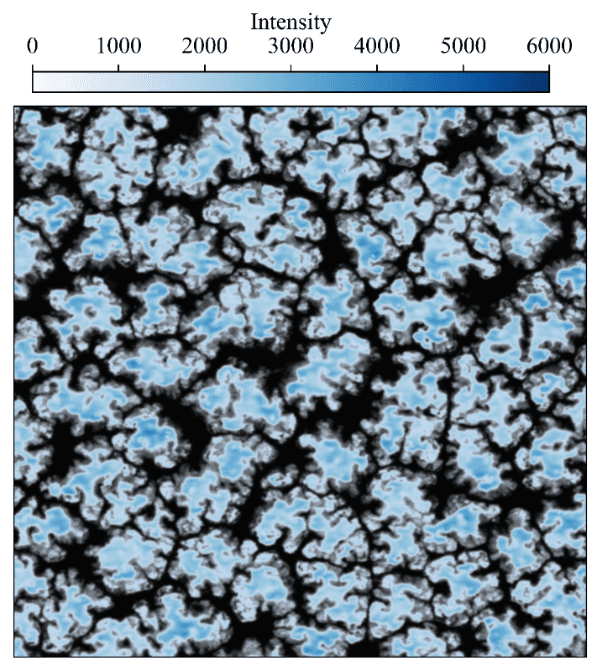
As winter settles in and the natural world fills with intricate seasonal patterns, our December Map of the Month turns its lens to a material that also holds striking internal geometry: bismuth vanadate (BiVO₄), a key photocatalyst for solar fuel generation.
Much like snowflakes illuminated under crisp winter light, BiVO₄ crystals reveal delicate and unique structural variations when examined using Raman microscopy. These subtle patterns, often invisible at first glance, can provide researchers with vital information about the potential efficiency and performance of the photocatalyst.
Raman spectroscopy is especially powerful for studying BiVO₄ because of its sensitivity to crystal structure, local bonding, and phase purity. Through high-resolution Raman mapping, we can observe characteristics such as crystallinity, lattice defects, and interactions with co-catalysts or reaction intermediates.
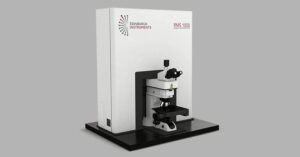
This Map of the Month highlights our recent Application Note where we demonstrate how the RM5 Confocal Raman Microscope uncovers performance-limiting heterogeneity across BiVO₄ crystals, offering valuable insights into their behaviour under operational conditions.
We would like to thank Dr Antonio Otavio Patrocinio and Dr Pablo José Gonçalves from the Federal University of Uberlândia and Federal University of Goiás, Brazil, for providing the BiVO4 sample used for these measurements.
If you would like to explore the full story behind this festive-season map, we invite you to read the complete Application Note.