Understanding what happens immediately after a molecule absorbs light is crucial across photochemistry, photocatalysis and materials research. While photoluminescence spectroscopy provides insight into radiative excited-state processes, transient absorption spectroscopy can probe excited states that relax non-radiatively, providing a window into dynamics that would otherwise remain hidden.
In this Edinburgh Instruments webinar, Georgios Arvanitakis explores the fundamentals of transient absorption spectroscopy and demonstrates how the Edinburgh Instruments LP980 Transient Absorption Spectrometer uses dual-mode detection to investigate both the spectral and kinetic behaviour of transient species.
Transient absorption is a pump-probe spectroscopy technique. An intense pump pulse excites the sample before a weaker probe beam monitors the resulting changes in absorption as the system evolves. This enables excited-state absorption, ground-state bleaching and relaxation dynamics to be investigated as a function of time.
By comparing the probe-only signal with the pump-plus-probe measurement, changes in optical density can be calculated to reveal transient spectral features and their evolution following excitation.
A key feature of the LP980 is its combination of two complementary detection approaches. An ICCD camera provides time-resolved spectral measurements, capturing a full spectrum at a selected delay after excitation. By acquiring spectra at multiple delays, researchers can build delay maps that show how transient spectral features evolve with time.
For detailed kinetics, the PMT detector measures transient absorption at a selected wavelength. Its nanosecond rise time makes it suited to capturing fast kinetic behaviour, with the resulting transient decay recorded by an oscilloscope.
Together, these detection modes provide complementary views of the same photophysical process: ICCD detection for spectral information and PMT detection for kinetic information.
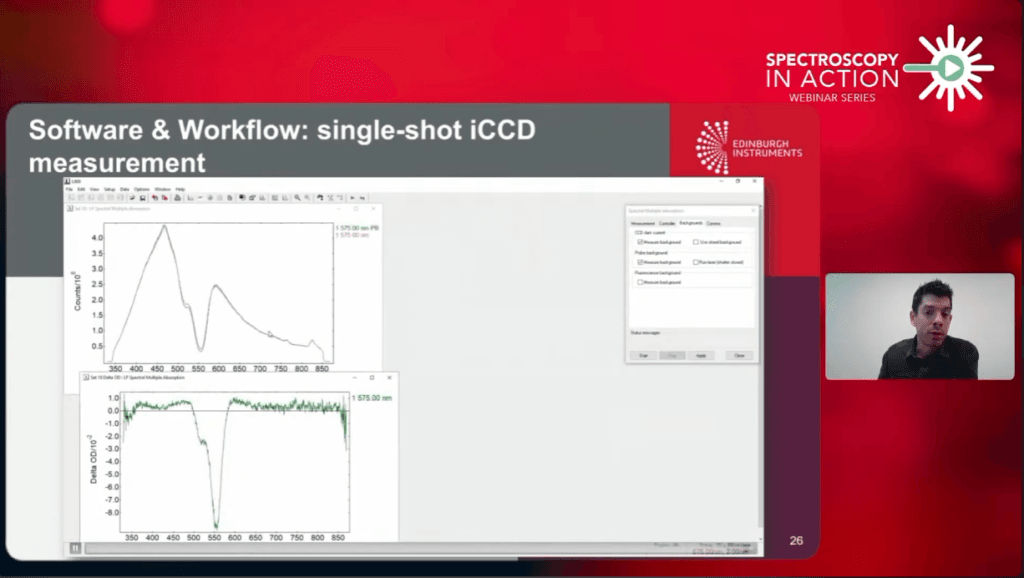
The webinar demonstrates the LP980 software using Rose Bengal measurements, showing the acquisition of transient absorption spectra and time-resolved delay maps with ICCD detection. It also demonstrates PMT measurements at a selected wavelength and exponential fitting within the software to analyse transient kinetics.
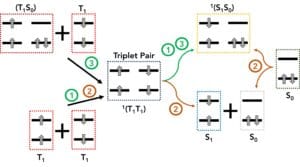
The LP980 can accommodate a variety of sample formats, including liquids, thin films, powders, non-transparent films and glass samples using dedicated sample holders and measurement geometries. Applications discussed in the webinar include photocatalysis, photodynamic therapy, triplet-triplet annihilation upconversion, solar-energy research and OLED studies.
Watch the full webinar to hear Georgios Arvanitakis explain the fundamentals of transient absorption spectroscopy, and how dual ICCD and PMT detection on the LP980 Transient Absorption Spectrometer provides complementary spectral and kinetic insight into excited-state dynamics.