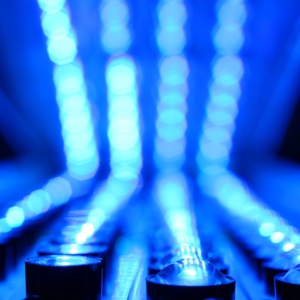
Phosphor-converted white light-emitting diodes (pc-WLEDs) are at the forefront of lighting development due to their low power consumption and highly stable emission. Fundamentally, pc-WLEDs are comprised of a UV or blue-emitting LED encased in a phosphor that converts the electroluminescence into a mixture of wavelengths that are perceived as white light (Figure 1a).
Within this field, lead-free perovskites such as Sb3+-doped Rb2HfCl6 (Rb2HfCl6:Sb) have become increasingly popular phosphor materials for pc-WLEDs due to their tunable bandgap, long carrier lifetime, and propensity to form self-trapped excitons (STEs). STEs are excited state pairs of electrons and holes that become localised due to coupling with lattice phonons, resulting in stable broadband emission ideal for lighting applications.
Here, we highlight the work of researchers from Dalian Maritime University, published in Materials, in which the authors synthesised Rb2HfCl6:Sb crystals to act as a phosphor for a pc-WLED (Figure 1b).
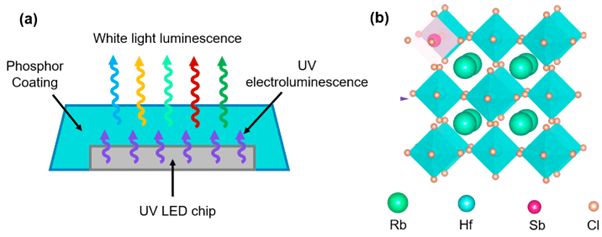
Figure 1: (a) Schematic of a pc-WLED in operation. (b) Crystal structure of Sb3+-doped Rb2HfCl6. Reprinted with permission from Y. Li and Y. Gao.1
To assess the viability of this material for this application, it was crucial to determine its emission and its underlying photophysical processes. The Edinburgh Instruments FLS1000 Photoluminescence (PL) Spectrometer, along with key functionalities of the Fluoracle Software, were used to characterise the phosphor’s emission spectra and carrier lifetime, as well as measure electroluminescence (EL) of the material in a working pc-WLED.
Rb2HfCl6:Sb crystals were synthesised with concentrations of Sb3+ ions ranging from 0 – 12 %. PL excitation (PLE) spectra, emission spectra, time-resolved emission decays, and EL were measured on an FLS1000 equipped with a PMT-900 detector.
Under Xenon lamp excitation at 365 nm, the undoped Rb2HfCl6 was non-emissive. However, when doped with Sb3+, the samples exhibited broad emission bands at 500 and 630 nm that increased in intensity with the dopant concentration (Figure 2a). The 12% Sb3+-doped sample produced the highest intensity emission and thus was chosen for subsequent measurements.
Since doped perovskites such as these often exhibit excitation-dependent emission spectra, an Excitation-Emission Matrix (EEM) measurement was performed. In this measurement, emission spectra are collected for a range of excitation wavelengths to generate a 3-dimensional plot. These measurements have been made easy to perform by the dedicated EEM function of the Fluoracle software. This measurement showed that Rb2HfCl6:Sb exhibited maximum emission at 500 nm under 325 nm excitation, and a less intense emission band at 630 nm under 365 nm excitation (Figure 2b). It also showed that the ratio of the two bands could be tuned by varying the excitation wavelength. As the authors were aiming to produce a “warm” white light source, it was found that excitation at 365 nm produced the optimal combination of wavelengths for their application.
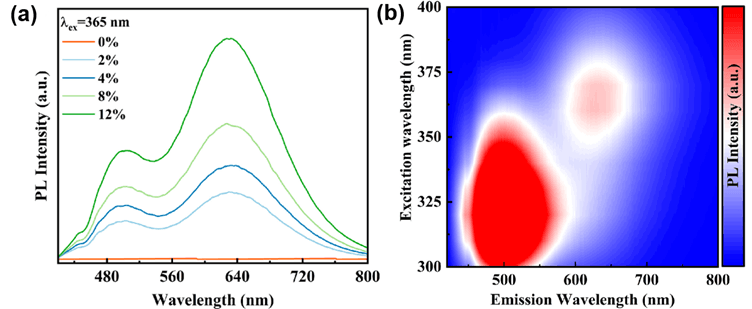
Figure 2: (a) Emission spectra of Rb2HfCl6 with increasing Sb3+ dopant concentration. (b) EEM of Rb2HfCl6. Reprinted with permission from Y. Li and Y. Gao.1
Next, time-resolved PL measurements were performed to understand the photophysical transitions of the material and to determine the carrier lifetime. A long, microsecond lifetime is an important property of efficient LED materials as it indicates that fast non-radiative processes have been minimised. Time-resolved measurements were performed by Multichannel Scaling (MCS) under excitation from a pulsed EPL laser.
To determine how the material’s emission profile changes over time, a Time-Resolved Emission Spectra (TRES) measurement was performed using the dedicated Fluoracle function. In this experiment, decays are collected for a range of emission wavelengths. This data may be represented as a 3-dimensional plot, showing that the two main emission bands at 500 and 630 nm occur on different timescales and arise from distinct emission centres (Figure 3a). By using the TRES data slicing function of Fluoracle, the emission spectra at different time periods are revealed. On a shorter timescale (0 – 8 µs), the two emission bands are present, reflecting the steady-state emission. However, on a longer timescale (9 – 18 µs), only the 630 nm band is present (Figure 3b).
Extracting decays from the TRES plot and performing fitting allowed determination of the carrier lifetime at individual wavelengths. At 500 and 630 nm, the decays possessed two exponential components with average lifetimes of ~83 ns and ~7 µs, respectively. The TRES data allowed the authors to assign the short and long lifetimes bands as arising from STE singlet and triplet excited states, respectively. Also, the microsecond lifetime of the 630 nm band showed that the material was exhibiting efficient radiative charge carrier recombination.
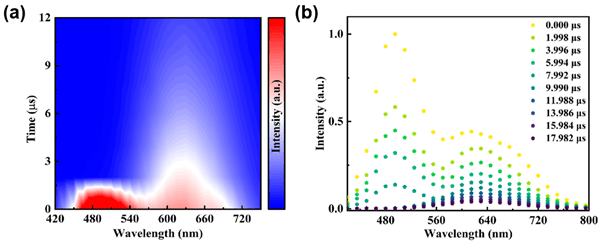
Figure 3: (a) TRES 3D plot and (b) TRES time slices of Rb2HfCl6:Sb. Reprinted with permission from Y. Li and Y. Gao.1
The spectral and lifetime PL properties of Rb2HfCl6:Sb showed it possessed strong potential as a WLED material. As such, the phosphor was integrated into a pc-WLED structure using a commercial 365 nm LED chip and its emittance was measured using the emission arm of the FLS1000. The working WLED exhibited broad emission as previously observed during PL measurements (Figure 4a). Using the Chromaticity function of Fluoracle, emission spectra may be plotted in CIE colour space, which defines how mixtures of visible light are perceived by human eyes. The CIE coordinates of the pc-WLED were (0.45, 0.41), which corresponds to warm white light (Figure 4b). The EL spectrum was used to calculate the colour rendering index (CRI), which describes the ability of a light source to show an object’s colour compared to natural daylight. The CRI was found to be 81.9, indicating high rendering performance.
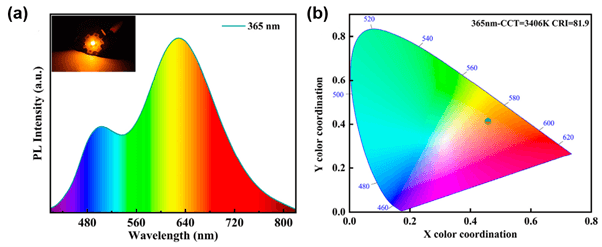
Figure 4: (a) EL spectrum from pc-WLED comprising Rb2HfCl6:Sb. Inset: Photograph of operational device. (b) CIE 1931 colour coordinates of pc-WLED. Reprinted with permission from Y. Li and Y. Gao.1
This Research Highlight has shown how the versatility of the FLS1000 allowed the authors to not only study the fundamental properties of their material, such as the emission spectrum and carrier lifetime, but also measure its emittance in a working pc-WLED. The dedicated EEM and TRES functionalities of the Fluoracle software were used to show how the colour of Rb2HfCl6:Sb emittance can be tuned with the excitation wavelength, and allowed assignment of the electronic transitions of emission bands. Moreover, using the software’s Chromaticity functionality, the authors were able to convert the emission spectrum of their operational pc-WLED into CIE colour coordinates, an essential metric for any lighting application.
This article was published in Materials.
References