
PLQY is one of the most important parameters for characterising a luminescent material. While the concept is simple, obtaining an accurate PLQY can become more challenging when samples reabsorb their own emission, produce very weak signals, or introduce additional background.
In this Edinburgh Instruments webinar, Grant Cumming and Dr Tommy Loan explore the fundamentals of relative and absolute photoluminescence quantum yield, before moving on to practical approaches for obtaining reliable absolute PLQY measurements from both straightforward and more challenging samples.
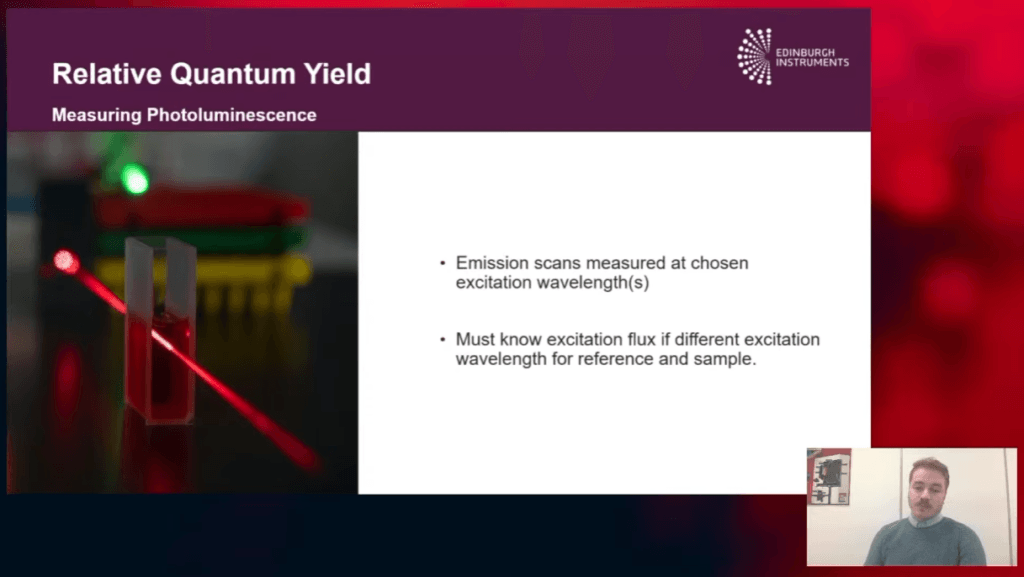
Relative quantum yield determines the PLQY of an unknown sample by comparison with a well-characterised reference. Ideally, the reference should absorb and emit in a similar spectral range and have a PLQY close to that of the sample.
Although accessible, the relative approach depends on finding a suitable reference and accounting for the directionality of emitted light. Absolute PLQY overcomes these limitations using an integrating sphere, which collects light emitted in all directions simultaneously.
The absolute method determines PLQY from the number of photons emitted relative to the number absorbed. Measurements of the sample are compared with a blank, with the integrating sphere collecting both scattered excitation light and sample emission. In straightforward measurements, PLQY can be calculated from as little as two emission scans.
Good measurements start with careful sample preparation and parameter selection. For liquid samples, optically matched cuvettes and identical sample and blank volumes are recommended, while powder samples should completely cover the bottom of the sample tray and be carefully prepared to minimise contamination. Excitation wavelength, bandwidth, spectral range, resolution and integration time must then be selected to capture both excitation and emission accurately with sufficient signal-to-noise.
One complication in absolute PLQY measurements is the inner-filter effect. For samples with a low Stokes shift, absorption and emission can overlap, allowing the sample to reabsorb some of its own emitted light. The measured emission can therefore underestimate the true PLQY.
The webinar demonstrates how reabsorption can be identified by comparing emission measured inside the integrating sphere with the true emission spectrum measured outside the sphere at low sample concentration. The proportion of emission lost through reabsorption can then be quantified and used to calculate a corrected PLQY.
Weak samples present the opposite problem: intense excitation may be needed to obtain sufficient emission signal, but the resulting scattered excitation can saturate the detector.
One solution is to split the measurement into excitation and emission regions. A neutral density filter attenuates the scattered excitation signal, while the emission region is recorded without the filter to retain sufficient sensitivity. The excitation data can then be scaled to compensate for the filter before the PLQY is calculated.
This approach also extends absolute PLQY measurements to challenging luminescent systems such as upconversion materials, where two or more lower-energy photons are absorbed before a single higher-energy photon is emitted.
Watch the full webinar to hear Grant Cumming and Dr Tommy Loan explore PLQY measurements with Edinburgh Instruments, including practical demonstrations of data processing, reabsorption correction, weak-sample measurements and sphere background correction.